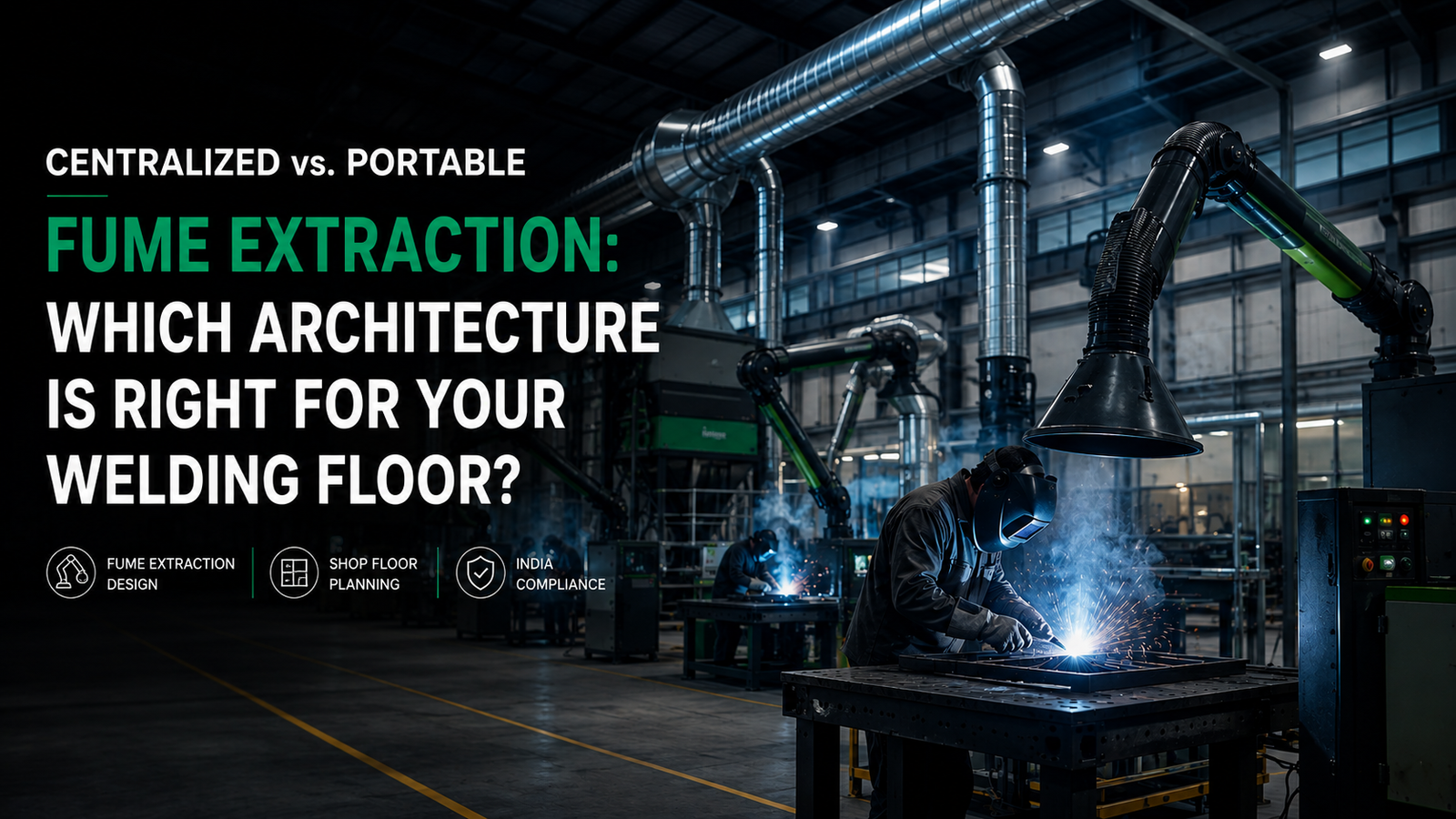
Centralized vs. Portable Fume Extraction: Which Architecture Is Right for Your Welding Floor?

The wrong extraction architecture costs more than the right one in filter spend, in compliance risk, and in worker health. Here’s how to read your floor and make the call correctly.

When a welding company in India starts looking at fume extraction, the first question that typically comes up is price. The second question   which should have come first   is architecture. Because a portable extractor in a shop that needs centralised extraction is not half a solution. It is no solution at all: inadequate airflow, constant repositioning, overwhelmed filters, and a compliance gap that a DGFASLI inspector will not miss.

The three extraction architectures portable, Standard Fume Extractor, and centralised   are not a good-better-best hierarchy. They are different tools for different floor configurations. Choosing between them correctly depends on four things: how many stations you run, how fixed your layout is, what processes you weld, and what your floor looks like in three to five years.

This guide walks through each architecture, when it works, when it doesn’t, and what a correctly designed floor looks like for small, medium, and large welding operations.

Where Does India Stand? Architecture Adoption Today

Before choosing your architecture, it helps to understand how Indian welding operations of different sizes currently use these systems   and where the most common mismatches occur.
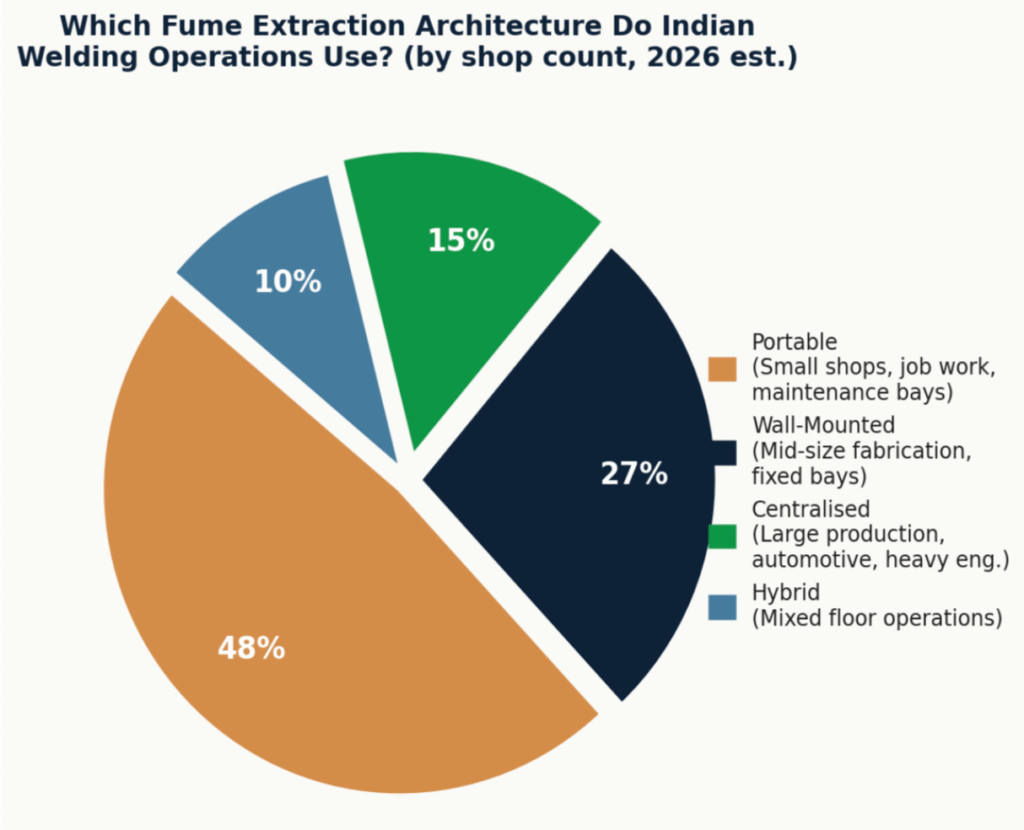
Portable extractors account for nearly half of all units in use across India   primarily because the majority of India’s welding operations are small job shops and fabrication units with 2–5 stations. This is correct for those operations. The problem occurs when shops scale to 8–12 stations without upgrading the architecture, running multiple portables where a Standard or centralised system would deliver better coverage at lower total cost.

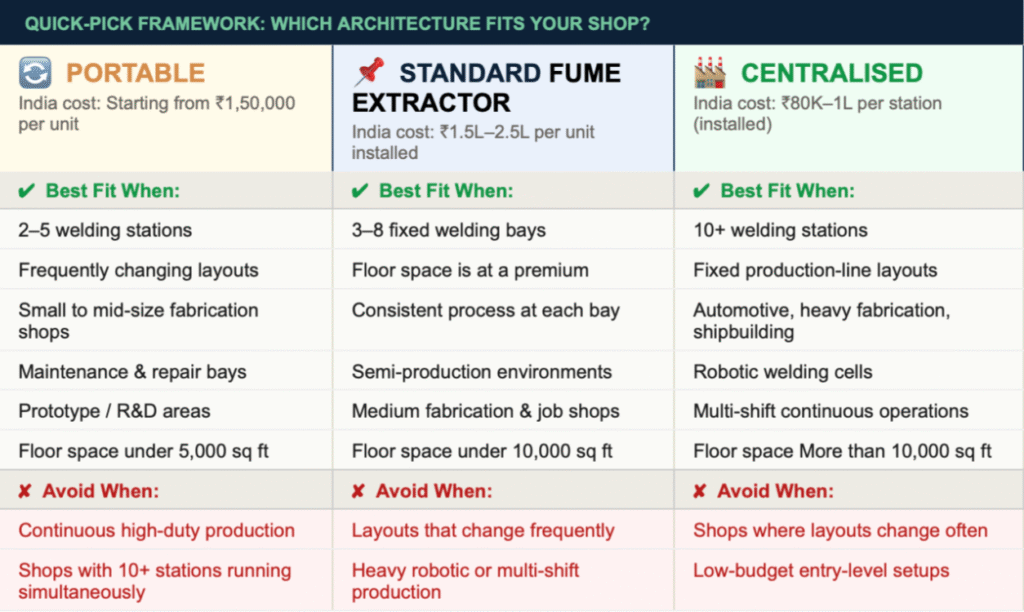
The Quick-Pick Framework

Before getting into the detail, here is the decision framework that mirrors how experienced buyers actually think through this choice:
Three Shop Sizes. Three Different Answers.

Most buying mistakes happen when a shop owner applies the logic of one scenario to a different one. Here’s what each scenario actually looks like:
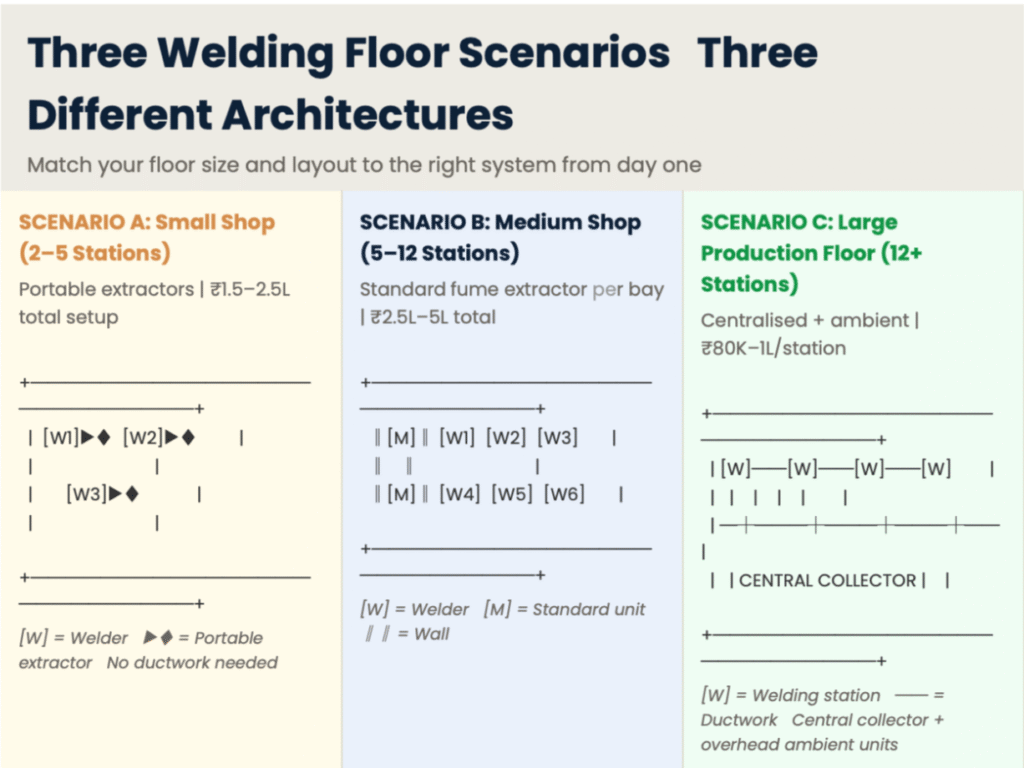


Scenario A: The Small Fabrication Shop (2–5 Stations)

A small job shop   structural steel fabrication, general engineering, custom metalwork   typically runs two to five welding benches with layouts that change as the work changes. Portable extractors are the right answer here, and not just for cost reasons. A fixed duct system that works perfectly for today’s bench layout becomes an obstacle when the layout changes. Portables give operators the flexibility to position extraction arms close to the arc where they need to be. Source capture at 100–150mm from the arc is the standard; a portable arm that’s repositioned correctly catches the fume before it enters the breathing zone. One that’s left in a corner does not.

Key buying consideration: CFM matters more than brand. A portable unit needs a minimum of 800–1,200 CFM with a multi-stage HEPA filter / Electrostatic Filter / cartridge Filters  for standard mild steel work. For stainless steel , specify H13 or H14 HEPA / Cartridge Filters regardless of unit size.

Scenario B: The Mid-Size Shop (5–12 Stations)

A mid-size fabrication shop, structural steel contractors, pressure vessel shops, automotive component manufacturers   typically have fixed welding bays with consistent processes at each bay. Standard extraction units per bay are the most cost-effective solution for this configuration. A Standard unit with one or two extraction arms services a fixed bay without consuming floor space. The practical ceiling for Standard architecture is around 8–10 bays. Beyond that, the total maintenance burden tracking filter replacement schedules across a dozen independent units   starts to argue for centralisation.

A Standard unit that is correctly sized and arm-positioned will out-perform an oversized centralised system with a poorly designed duct layout. Architecture matters less than execution.

Scenario C: The Large Production Floor (12+ Stations)

A large welding floor, automotive body shops, heavy equipment fabrication, shipbuilding, robotic welding lines has a fixed layout, high-duty continuous welding, and enough stations that per-station filter costs and maintenance complexity make centralisation the only economics that work. Centralised systems use a single high-capacity collector   typically 20,000 to 60,000 CFM   connected via ductwork to each welding station. A single maintenance event services the whole floor. Large floors also typically need ambient background filtration layered on top of source capture   ceiling-mounted recirculating units that continuously clean background air across the entire bay.

The Real Cost Comparison: 5-Year Total Ownership

Upfront price is only part of the story. Filter replacement, energy, and maintenance costs over five years often flip the economics in favour of a higher-capital architecture. Here is what the numbers look like across shop sizes:
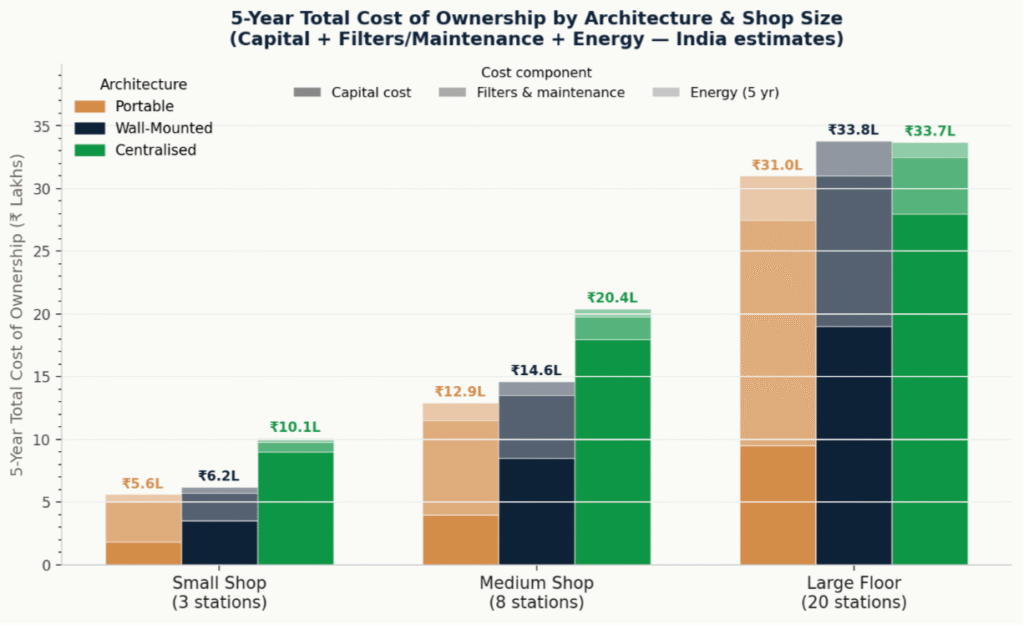
The chart makes two things clear. First, for small shops, portable is the right economic choice. The lower capital outlay and simpler maintenance more than offset the per-unit energy inefficiency. Second, at 20 stations, the centralised total cost of ownership is meaningfully lower than running 20 independent portable units, despite the higher upfront investment. The crossover point is typically around 8–10 stations depending on duty cycle and filter replacement frequency.

Head-to-Head: Every Factor That Matters in One Table

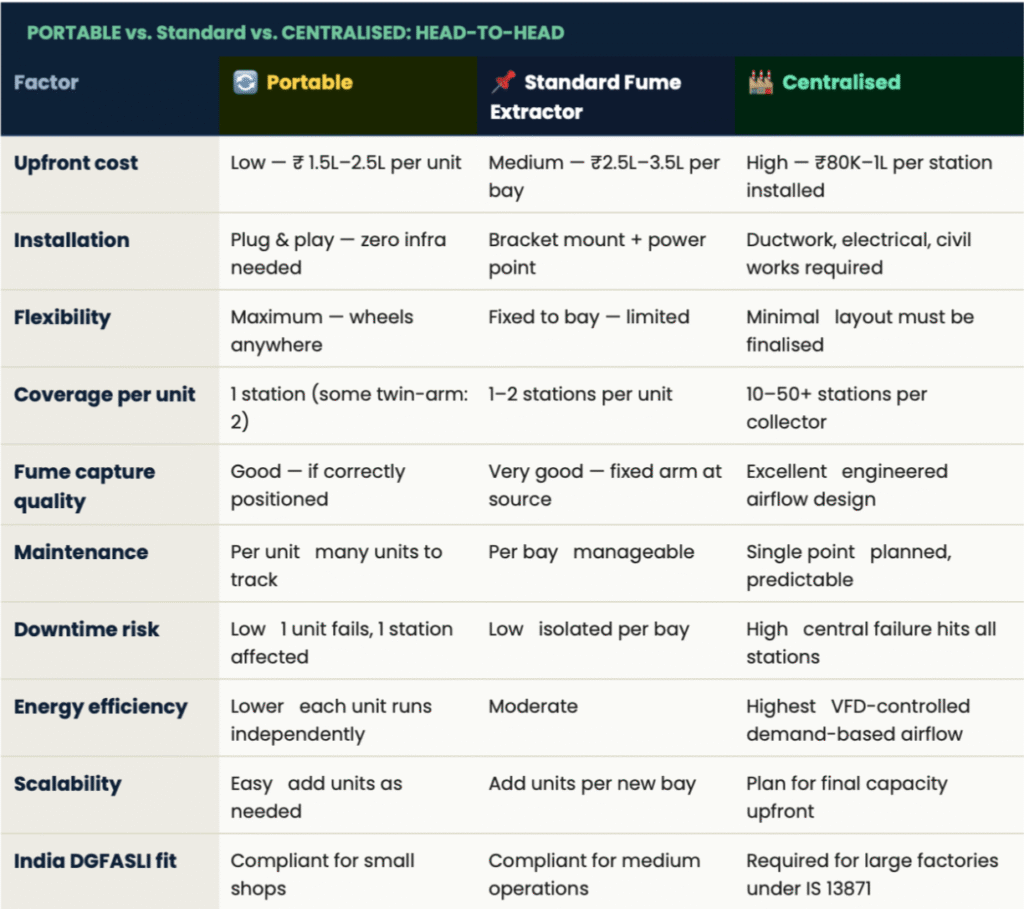
Here is how the three architectures compare across every decision factor a welding company actually cares about:
Why Execution Matters as Much as Architecture

Architecture selection is only half the decision. How a system is installed and operated determines whether it actually achieves DGFASLI-required fume capture levels. Here is what the data shows:
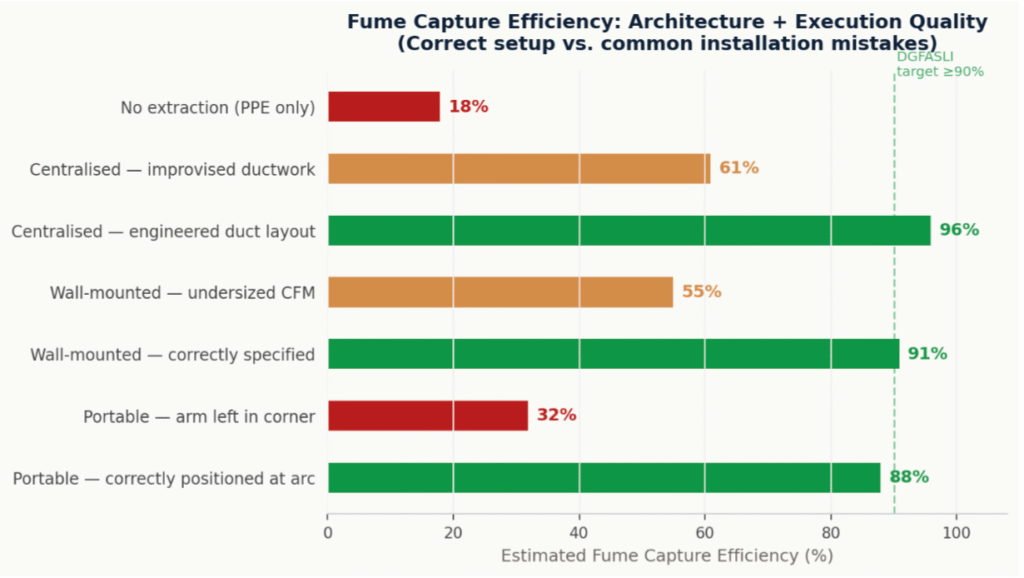
The single most important insight in this chart: a correctly positioned portable extractor (88% capture) outperforms an undersized centralised system with improvised ductwork (61%). Architecture is not a substitute for correct specification and installation. A centralised system that is properly engineered delivers 96% capture efficiency   but one with poorly designed duct branches can fall below DGFASLI’s effective target of 90% while looking compliant on paper.

The Hybrid Architecture: What Most Real Floors Actually Need

Most medium-to-large Indian welding operations have multiple zones   each with different processes, different layout stability, and different hazard levels. A hybrid approach with different architectures for different zones nearly always outperforms a single-architecture approach on both cost and compliance.
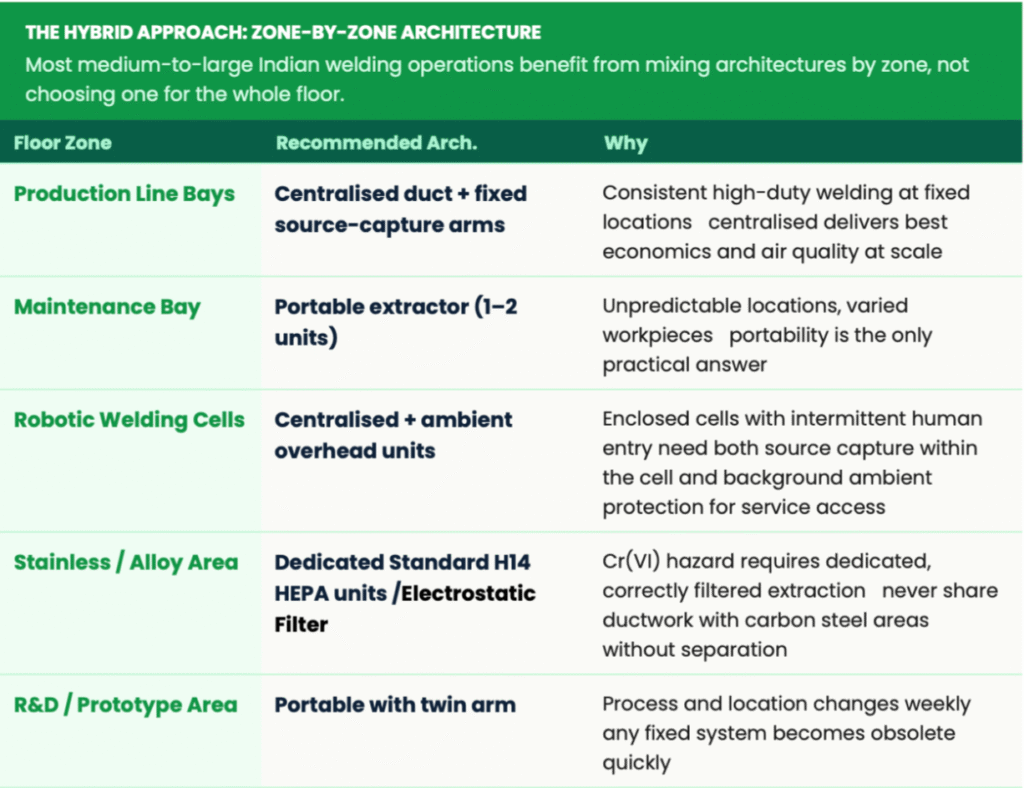


Many facilities built or expanded between 2015 and 2025 use a hybrid approach: centralised systems for fixed production lines and portable units for maintenance bays, specialty cells, or areas with unpredictable welding locations. This is not a compromise, it is correct engineering.

The Decision Checklist Before You Buy

Run through these questions before committing to any architecture:

  • How many welding stations do you run simultaneously   and what is that number in three years?
  • Is your floor layout fixed, or does it change based on the job?
  • What processes are running at each station   and does any station run stainless or alloy welding?
  • Do you have the electrical infrastructure and civil access for ductwork, or would installation be disruptive?
  • What is your maintenance model   in-house team, or must maintenance be minimal and predictable?
  • Are any zones enclosed or confined   robotic cells, booths   that need separate extraction treatment?

Architecture first. Equipment second. The answers to these questions, not the price tag on a unit, determine which system is right for your floor.

Greenwich Air Filtration — Fume Extraction System Design

Greenwich designs portable, Standard, Standard Fume Extractor , Semi Centralized  Centralised, and hybrid fume extraction systems for Indian welding operations. Our FEX & DEX Series covers all three architectures with DGFASLI and CPCB-compliant configurations. We offer free shop-floor assessments including airflow modelling, process-specific filter specification, and ductwork design before any system is sized or quoted.

#GreenwichSolutions  #IndustrialAirSafety  #CleanAirSolutions  #FumeExtractor  #DustCollector
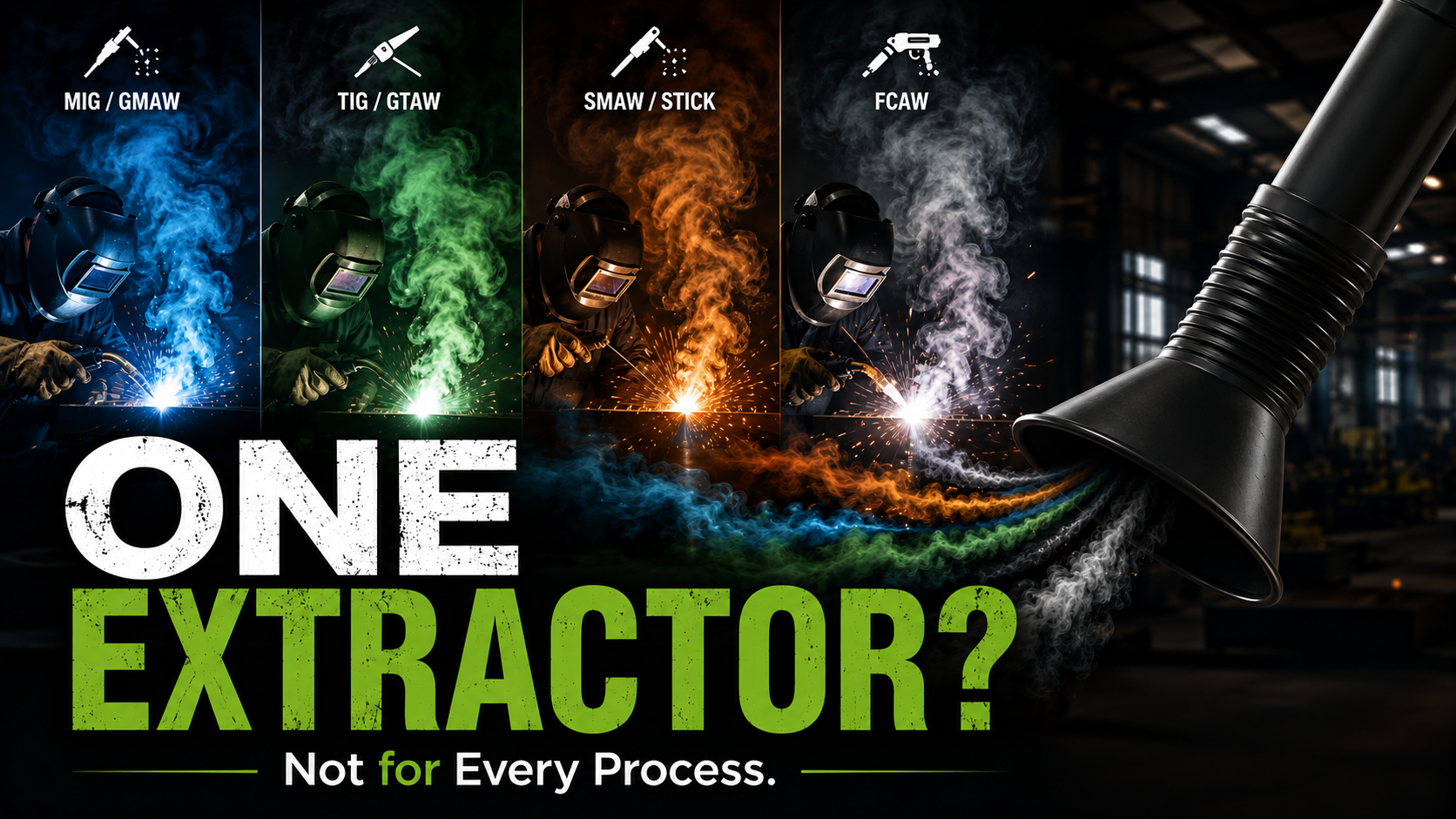


MIG, TIG, SMAW, FCAW: Each Process Produces a Different Fume. Is Your Extractor Built for the Right One?

Most welding shops run more than one process. Most welding shops also run a single extractor configuration across all of them. That gap is where worker exposure and compliance risk lives.

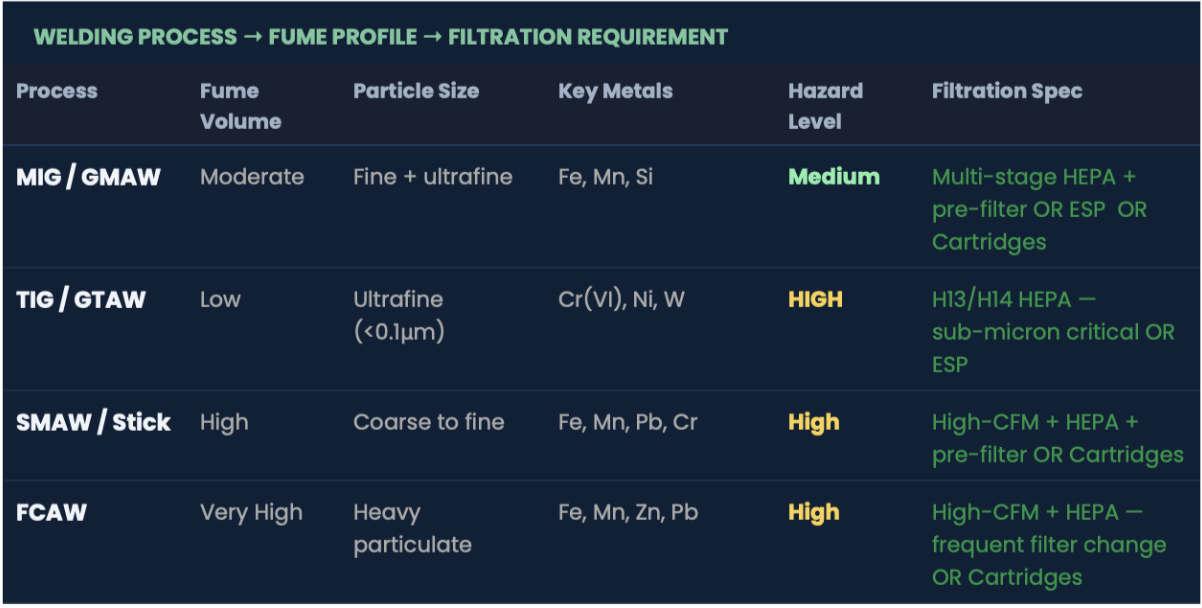
Walk into any Indian fabrication workshop and you’ll find welders running MIG on structural steel in one bay, TIG on stainless components in another, and stick welding on heavy sections in a third. Each process generates fumes. But those fumes are not the same not in volume, not in particle size, and not in toxicity. And the extractor that handles one well may be almost useless for another.

This matters because DGFASLI inspections and CPCB guidelines don’t just ask whether you have a fume extractor. They ask whether you’ve controlled fume exposure at the source. An undersized or mismatched extractor fails that test on paper and in practice.

Here’s what every welding company operating in India needs to understand about matching fume extraction to process.

Why Process Type Determines Everything

Welding fumes are not one substance. They are complex mixtures of metallic oxides, particulate matter, gases, and in some cases, known carcinogens. The composition and therefore the hazard level and filtration requirement changes dramatically depending on what you’re welding, what consumables you’re using, and how you’re doing it.

The most critical distinction is between processes that generate high volumes of fumes and those that generate lower volumes but contain highly toxic contaminants. TIG welding is the clearest example. It produces relatively little visible smoke, leading many welding shops to assume it is a low-risk process. It is not.

When used on stainless steel, TIG welding generates hexavalent chromium, a Group 1 IARC carcinogen, in ultrafine particles that can penetrate deep into the pulmonary region of the lungs. A standard pre-filter cannot capture these particles effectively. Only an H13 or H14-rated HEPA filter, an ESP combination system, or a cartridge filtration system can capture them reliably.

Low visible fume does not mean low hazard. TIG on stainless produces hexavalent chromium in particles small enough to reach the deepest part of the lung. It is the most underestimated exposure risk on the welding floor.

The 4 Filtration Technologies and When Each One Is Right

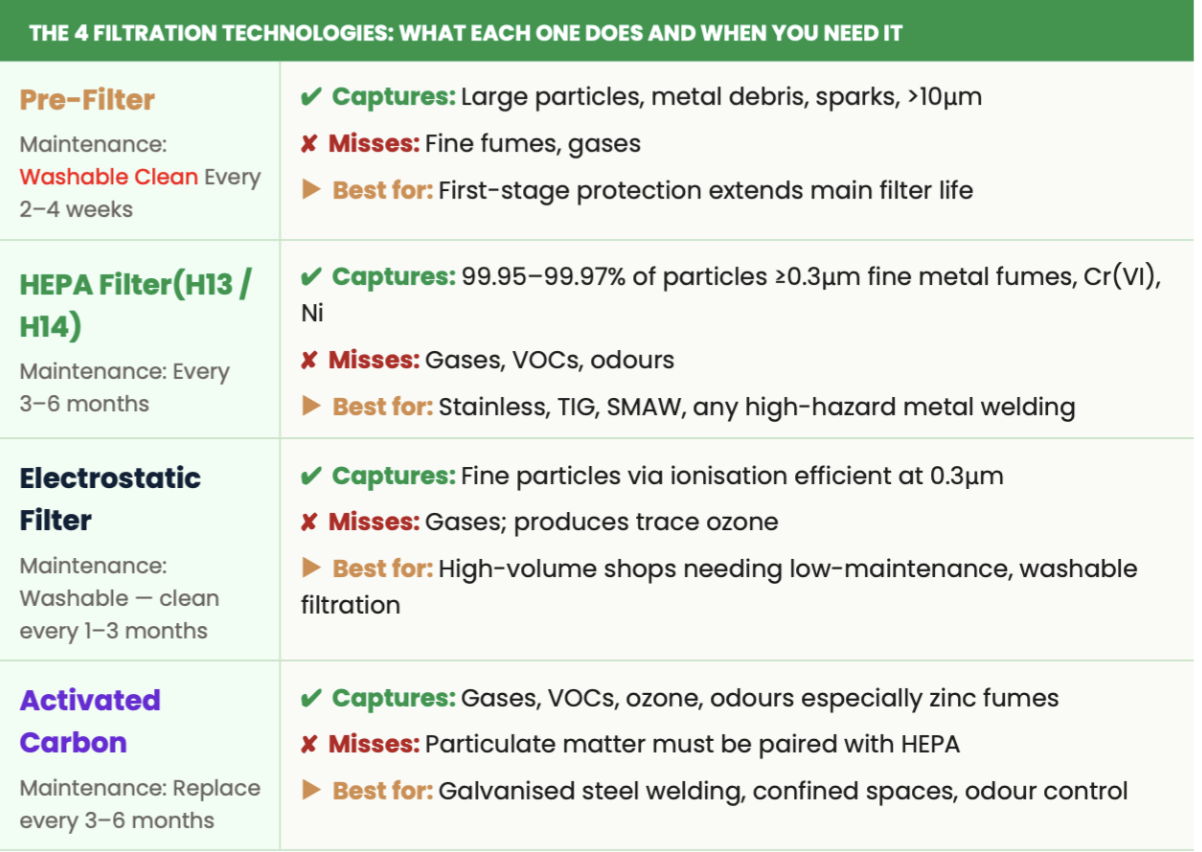
No single filter technology handles everything. Effective fume extraction in a serious welding operation is a multi-stage system, where each layer does a specific job. Understanding what each technology does and critically, what it misses is the foundation of a correctly specified extractor.

The sequencing of filtration stages is just as important as the technology itself. A HEPA filter installed without an upstream pre-filter will clog quickly, reducing its service life, increasing replacement costs, and creating potential compliance gaps. Similarly, an activated carbon layer used without effective particulate filtration can control gases and odours but allows fine metal fumes to pass through.

Multi-stage filtration systems are effective because each stage protects and enhances the performance of the next. An ESP combination system, consisting of a pre-filter, aluminium wire mesh, ESP module, and activated carbon filter, delivers excellent filtration for applications involving both particulate matter and gaseous contaminants. For welding applications, cartridge filtration remains one of the most effective technologies, offering high-efficiency capture across virtually all types of welding fumes.

India’s Compliance Framework: What the Law Actually Requires

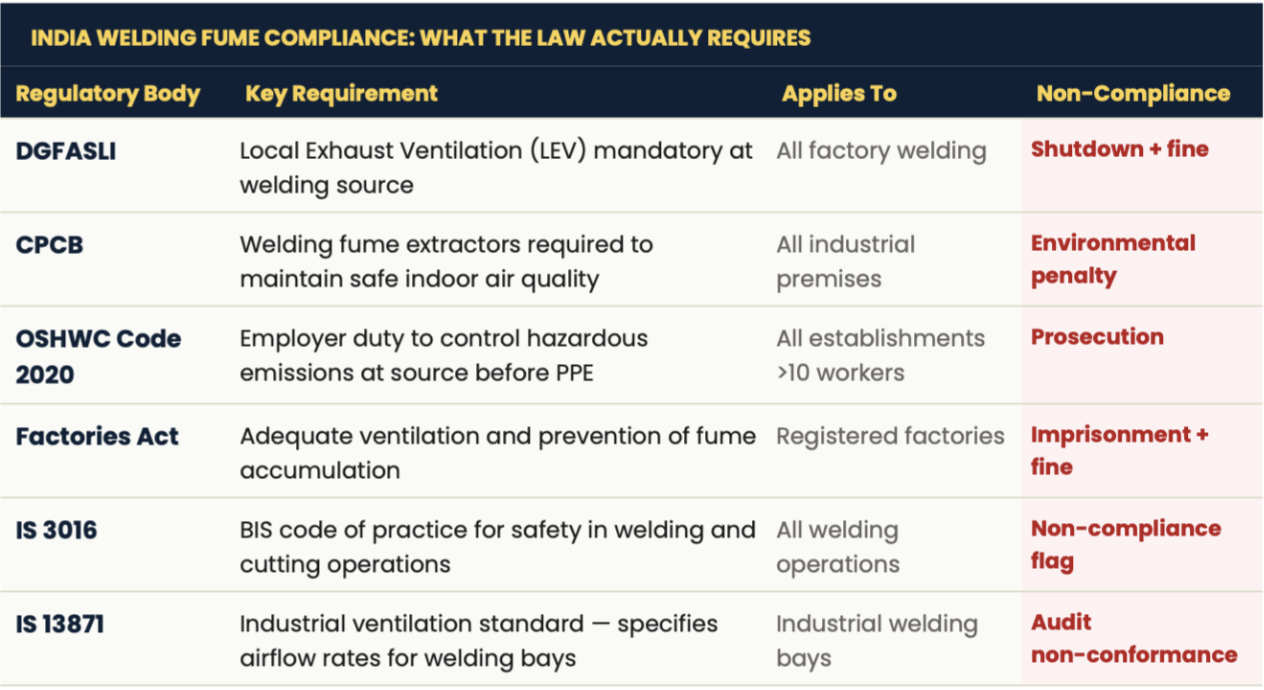
The regulatory environment around welding fume in India has tightened significantly under the OSHWC Code 2020 and updated CPCB guidelines. The key shift: the burden of proof has moved from ‘we have ventilation’ to ‘we have controlled exposure at the source.’ That is a meaningful difference in what inspectors look for.

Two standards deserve particular attention for welding operations. IS 3016, the BIS Code of Practice for Welding Safety, specifies that fume control should follow the hierarchy of controls, prioritising engineering controls, such as source extraction, before administrative controls, such as job rotation, and personal protective equipment (PPE), including respirators. This hierarchy is critical. If respirators are your primary means of controlling welding fumes, you are not meeting the intent of the standard, even if every welder is wearing one.

IS 13871, the industrial ventilation standard, specifies the minimum ventilation requirements for welding areas. For stainless steel and alloy welding involving chromium or nickel, higher ventilation rates are required due to the increased health risks. The standard also recommends source capture extraction as the preferred control measure, rather than relying solely on general dilution ventilation.

Getting the Sizing Right: A Calculation Most Shops Get Wrong

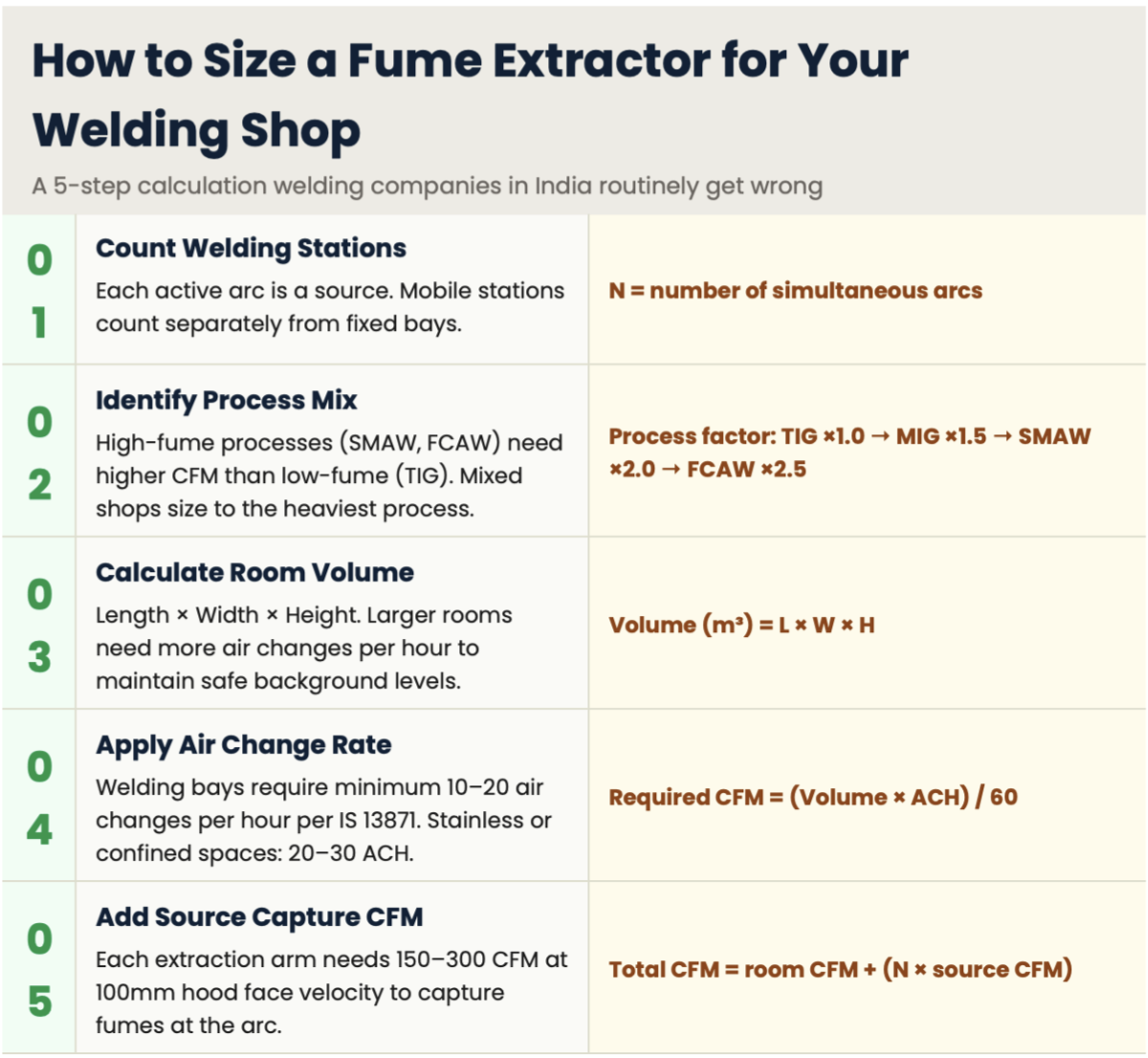
The most common extractor failure in Indian welding shops isn’t a broken unit. It’s an undersized one. A unit that can’t generate sufficient airflow at the arc simply doesn’t capture the fume at the source it disperses it into the breathing zone instead. Here’s how to size correctly:

One practical note: for shops running mixed processes, always size to the highest-hazard process in the bay not the average. If one station runs FCAW and another runs TIG, the FCAW process drives the CFM specification. The TIG station benefits from the headroom; the FCAW station is properly covered.

The Bottom Line for Welding Companies

A one-size-fits-all approach to fume extraction is a false economy. The cost of an incorrectly specified extraction system compounds over time through higher filter replacement costs as filters clog faster than intended, increased absenteeism and health-related liabilities, and compliance failures that can result in significant legal and financial consequences under India’s evolving regulatory framework.

The right approach is to specify the filtration system based on the welding process and the contaminants generated:

  • MIG Welding (Mild Steel): ESP combination systems with a pre-filter, cartridge filters, or multi-stage HEPA systems with a high-airflow pre-filter and source capture arm are all effective solutions.
  • TIG Welding (Stainless Steel): Cartridge filtration is the preferred solution. Alternatively, a multi-stage system with an H13 or H14 HEPA filter is essential for capturing hexavalent chromium (Cr(VI)) particles. An ESP combination system consisting of a pre-filter, ESP module, and activated carbon filter can also be used, but an ESP alone is not sufficient for Cr(VI).
  • SMAW / FCAW: High-CFM extraction systems with robust pre-filtration are recommended. Suitable options include ESP combination systems, cartridge filters, or multi-stage HEPA filtration, supported by a proactive filter maintenance schedule.
  • Galvanised Steel Welding: Cartridge filtration or HEPA filtration combined with activated carbon is recommended to effectively capture zinc oxide fumes and reduce the risk of metal fume fever.
  • Mixed Welding Shops: Use process-specific extraction systems rather than a single ambient unit. Zone-specific extraction arms paired with the appropriate filtration technology, whether ESP combination, cartridge, or multi-stage HEPA, provide significantly better protection and performance.

The question is not whether your welding shop has fume extraction. The question is whether it has the right extraction for every process running on your floor. Those are different questions with different answers.

About Greenwich Air Filtration

Greenwich designs and manufactures industrial air filtration systems for welding, dust collection, and oil mist control applications. Our FEX & DEX Series Fume Extractors are engineered for process-specific performance available in portable, wall-mounted, and centralised configurations for Indian industrial facilities. Contact our technical team for a free shop assessment and extractor sizing consultation.


The Welding Supervisor’s Honest Guide to DGFASLI Inspections: What They Check, What They Miss, What Gets You Shut Down.

An inspector doesn’t just check whether you have a fume extractor. They check whether it works, whether it’s positioned correctly, whether the filters were changed on time, and whether you can prove it. Here’s what actually happens on inspection day.

Most welding companies in India know three things about DGFASLI: it stands for something to do with factories, it can inspect your facility, and you need a fume extractor to be compliant. That knowledge covers roughly 20% of what an inspector actually looks at.

The other 80% the records, the documentation, the operator training logs, the ventilation calculations, the PPE registers is where the majority of violations are found. A welding shop with a functioning extractor at every station has still received prohibition orders because the filter replacement log was missing or the workers couldn’t demonstrate they’d been trained on fume hazards.

Note on naming: DGFASLI was officially renamed the Directorate General of Occupational Safety and Health (DGOSH) under the OSHWC Code 2020, which came into force on 21 November 2025. Most industry references and state enforcement agencies still use DGFASLI. This guide uses both terms interchangeably.

This guide is written for the welding supervisor or HSE manager who wants to know exactly what happens when an inspector walks through the door and what needs to be in order before that day arrives.

First: What DGFASLI Actually Has Authority to Do

Understanding the inspector’s powers matters because it shapes what you need to have ready not just on the floor, but on paper.

Inspection authority: Inspectors under the OSHWC Code 2020 can enter any registered factory without prior notice. They can examine workers, review records, take samples of materials, and test equipment. They do not need to give advance warning.

Prohibition orders: If an inspector finds conditions that pose immediate danger to worker health, they can issue an on-the-spot prohibition order halting specific operations without going to court first. This is the scenario welding companies fear most, and it is entirely preventable.

Prosecution: For non-compliance with the OSHWC Code, penalties run from ₹2 lakh to ₹3 lakh per violation. Falsification of records such as backdating filter replacement logs or forging training signatures is treated as a criminal offence with imprisonment provisions.

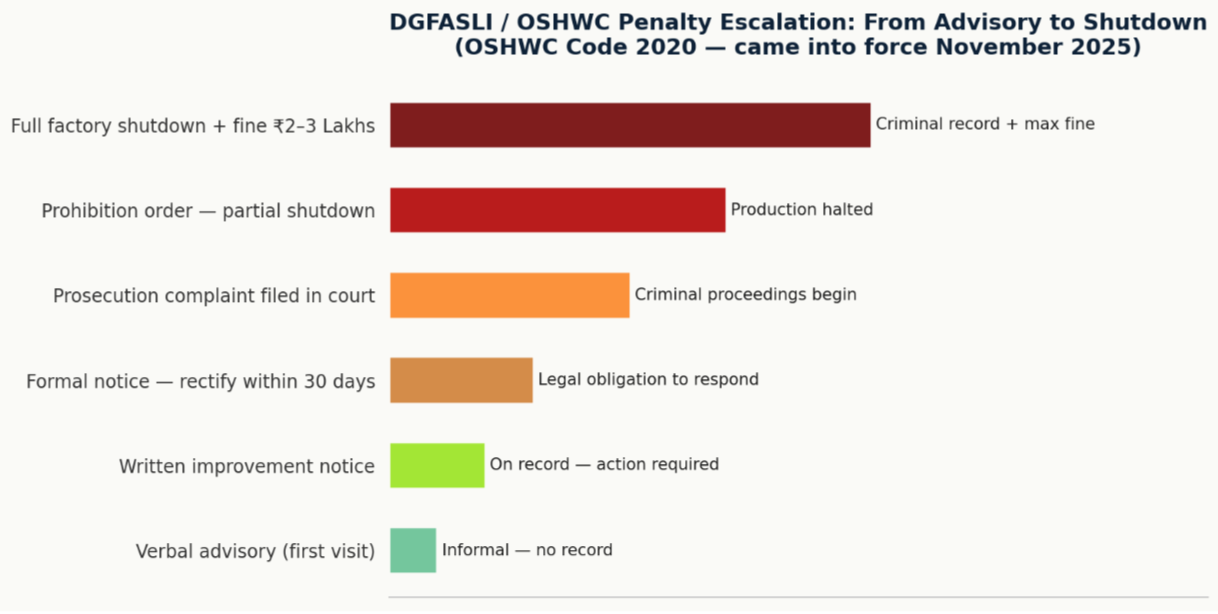
DGFASLI / OSHWC penalty escalation — from verbal advisory to full factory shutdown. The OSHWC Code 2020 came into full enforcement in November 2025.

What Inspectors Actually Check: The Real Sequence

Based on DGFASLI advisory guidelines, OSHWC Code 2020 enforcement patterns, and IS 3016 / IS 13871 requirements, here is what a welding floor inspection actually involves in the order inspectors typically work through it.

Stop 1: The Reception Desk — Before They Even Enter the Floor

Inspectors typically request these documents on arrival, before walking the shop:

  • Factory registration certificate and current licence under OSHWC Code 2020
  • Safety officer appointment letter (mandatory for factories with 500+ workers)
  • Last inspection report and actions taken
  • Accident register (Form 26 under previous Factories Act — equivalent under OSHWC)
  • Workers’ health examination records (mandatory for workers in hazardous processes)

If these aren’t at the reception desk in an organised file, you’ve already started poorly. Inspectors take note of document readiness as an indicator of overall compliance culture.

Stop 2: The Welding Bay — Hardware First

The first physical check is hardware — what’s installed, where it’s positioned, and whether it’s actually running. The single most common immediate violation: an extractor that is present but not positioned correctly.

An extraction arm hanging in the corner three metres from the arc is not compliance. It is furniture. The CPCB mandate for local exhaust ventilation means capture at the source — within 300mm of the welding arc. Distance is the variable most shops get wrong

Inspectors specifically look for:

  • Is the extractor switched on during active welding — or switched off to reduce noise?
  • Is the extraction arm positioned close enough to the arc to create visible fume capture?
  • Is there any visible fume escaping into the welder’s breathing zone?
  • Are there bypass valves, blocked ports, or disconnected ducts on any unit?
  • Is there a spark arrestor fitted where processes generate sparks?

Stop 3: Stainless Steel and Alloy Welding Stations — Separate and Stricter

If your facility welds stainless steel, high-chromium alloys, or nickel-based materials, expect a separate and more detailed check at those stations. Cr(VI) — hexavalent chromium — is a Group 1 carcinogen under IARC classification. CPCB has specific guidelines for Cr(VI) exposure that go beyond standard fume extraction requirements:

  • NABL-accredited air sampling results are expected on file — not just hardware presence
  • H13 or H14 HEPA filtration ,ESP Filtration & Cartridge Filtration is effectively required — standard filters are inadequate for Cr(VI)
  • Separate extraction circuit recommended — mixing stainless station ducts with carbon steel stations contaminates the carbon steel station’s exhaust with Cr(VI)
  • Respirators at stainless stations must be minimum FFP3 / P3 grade — not standard welding shields

The Common Violations: What Actually Gets Flagged

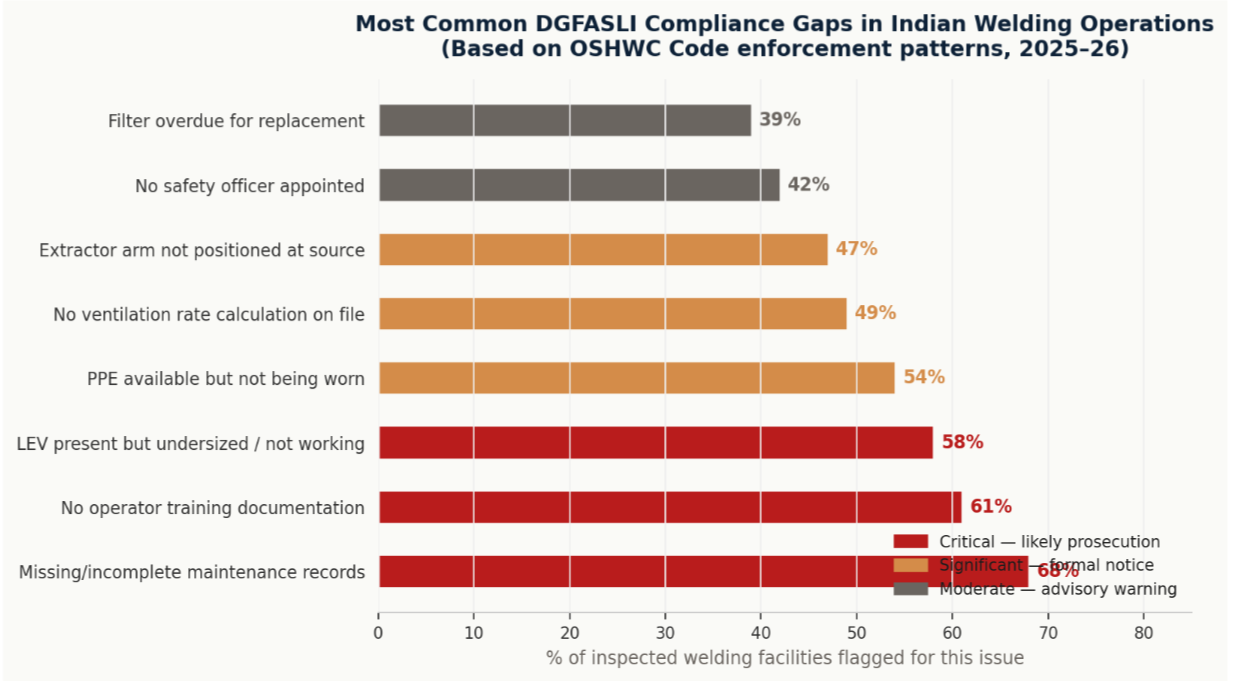
Most common DGFASLI compliance gaps in Indian welding operations (OSHWC Code enforcement patterns, 2025–26). Red = critical, amber = significant, grey = moderate.

The most frequent finding is not missing hardware — it’s missing records. A shop can have a functioning extractor at every station and still fail an inspection because it cannot produce a filter replacement log, a training record, or a ventilation rate calculation.

The ‘it exists’ trap: Many welding companies believe that having PPE available means they are compliant. Inspectors check whether it’s being used, whether it was issued (register), whether it’s in serviceable condition, and whether workers have been trained on its correct use. Having 10 helmets in a cupboard satisfies none of those four checks.

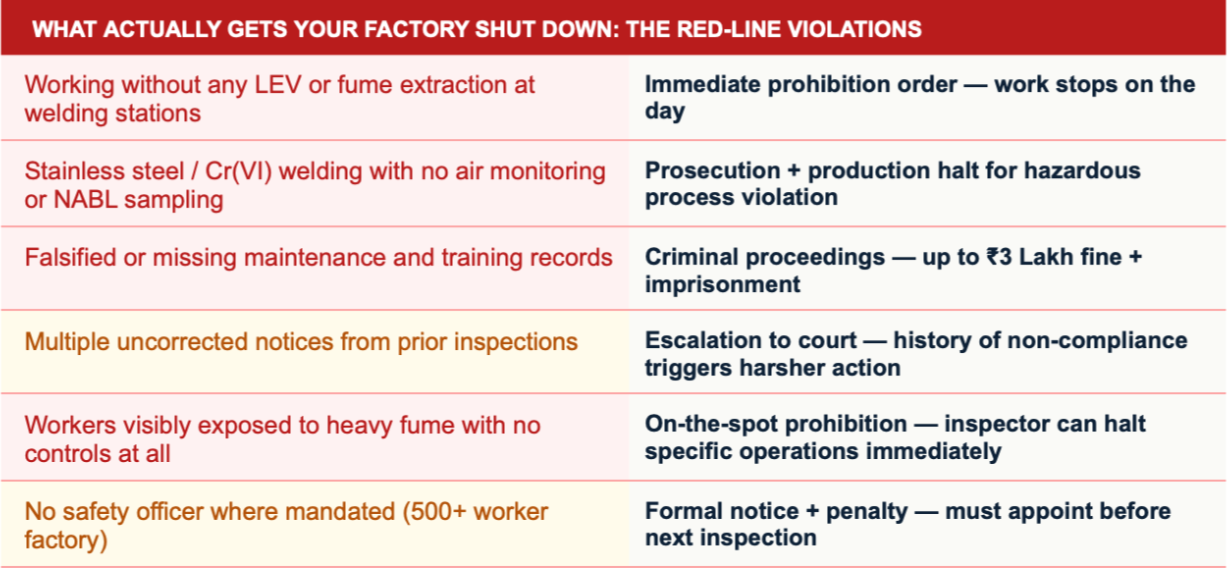
What Gets You Shut Down: The Red Lines

The prohibition order is the outcome every welding company wants to avoid. The important thing to understand is that inspectors do not want to shut factories they want compliance. First-time violations where the employer shows willingness to correct typically result in a written notice with a 30-day rectification window. The escalation to shutdown happens when violations are repeated, when records are falsified, or when the inspector judges that immediate danger to workers exists.

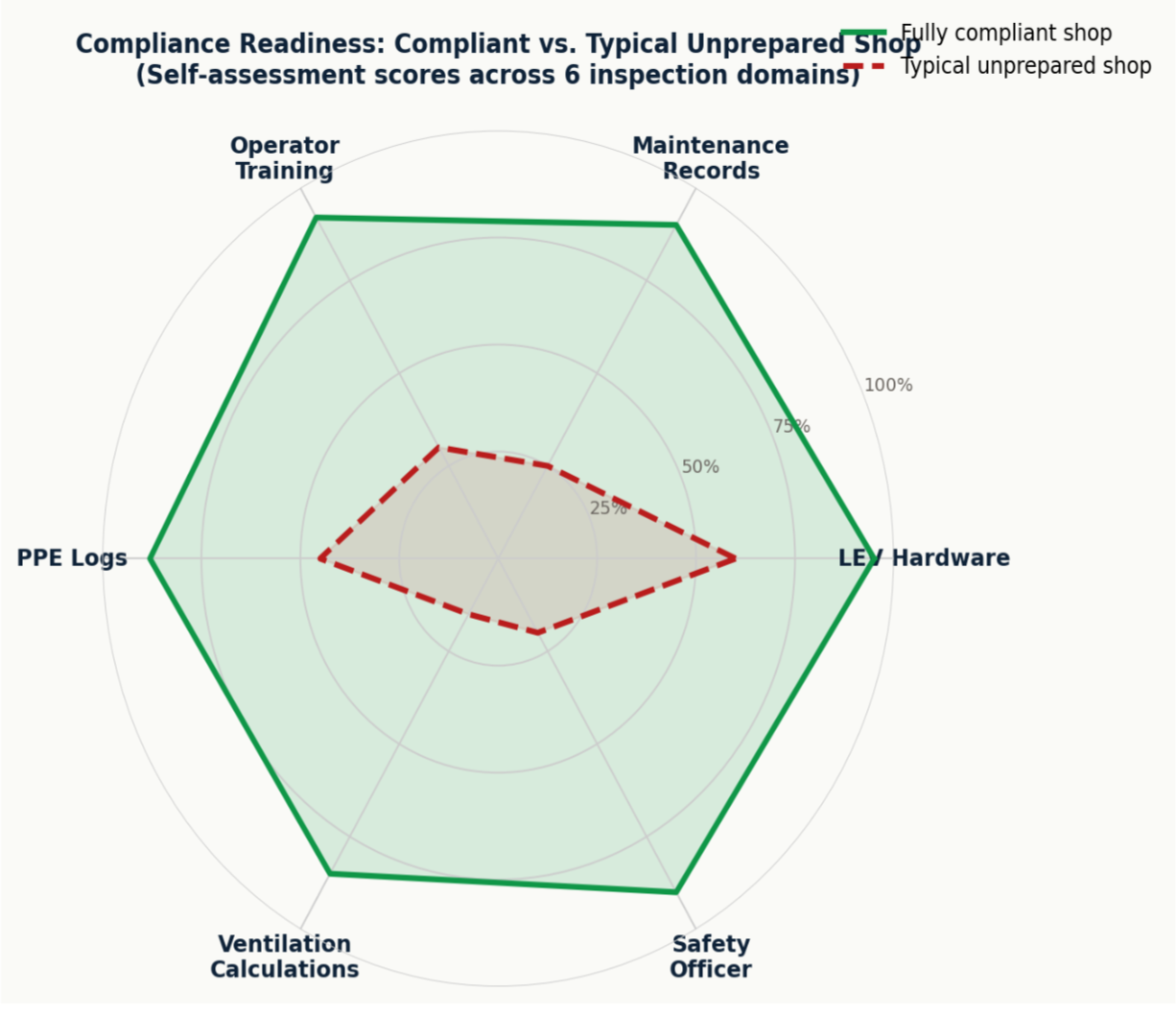
The Compliance Readiness Check: Where Does Your Shop Stand?

The radar chart shows where the compliance gap typically lives. Hardware LEV presence scores reasonably in most shops. The severe gaps are in maintenance records, operator training documentation, and ventilation calculations the paper trail that proves the hardware is working correctly and consistently.

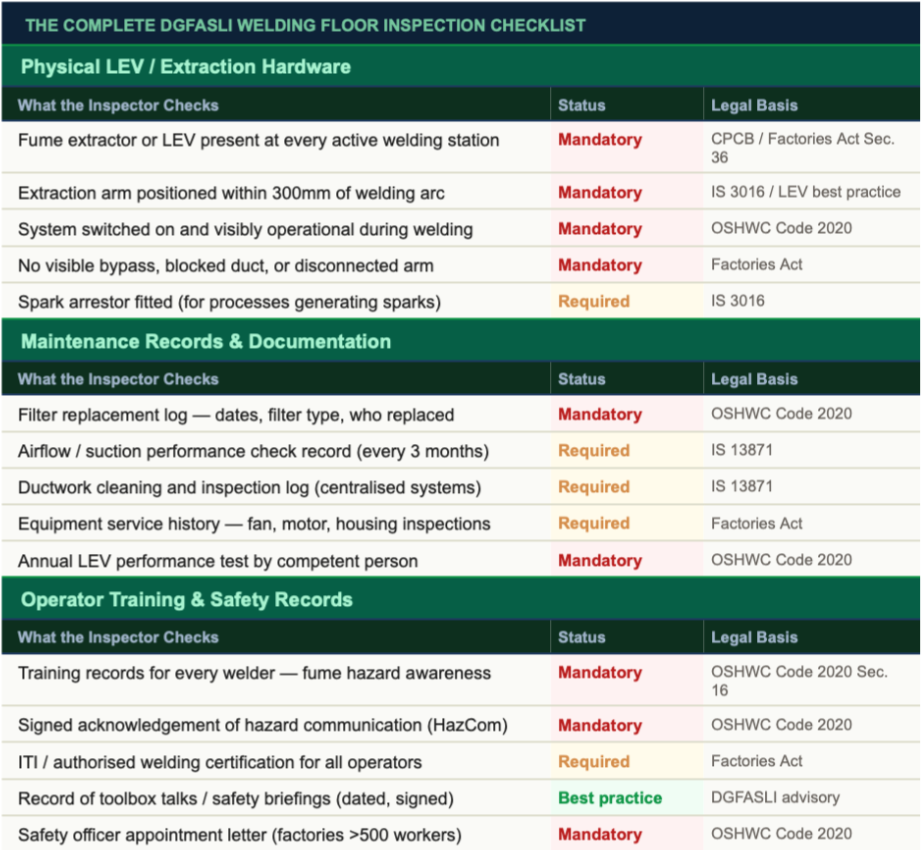
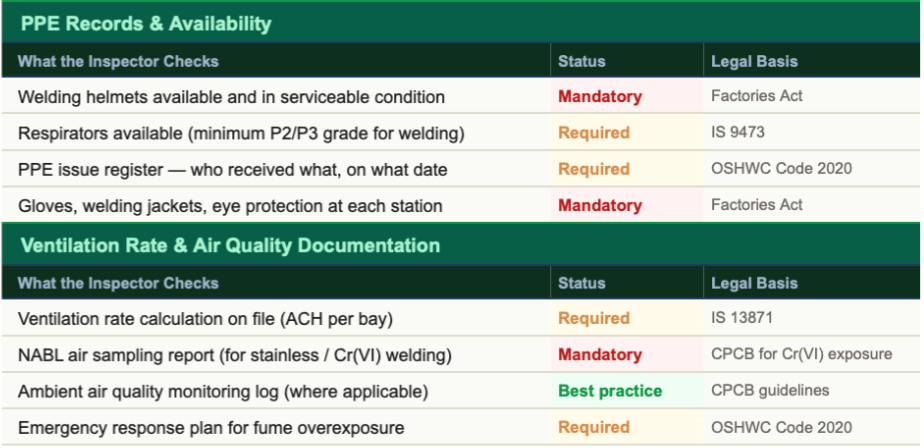
The Complete Inspection Checklist

Use this against your own floor before an inspector does. Every row marked Mandatory carries legal weight under the OSHWC Code 2020 or the Factories Act (where OSHWC transition rules still apply).

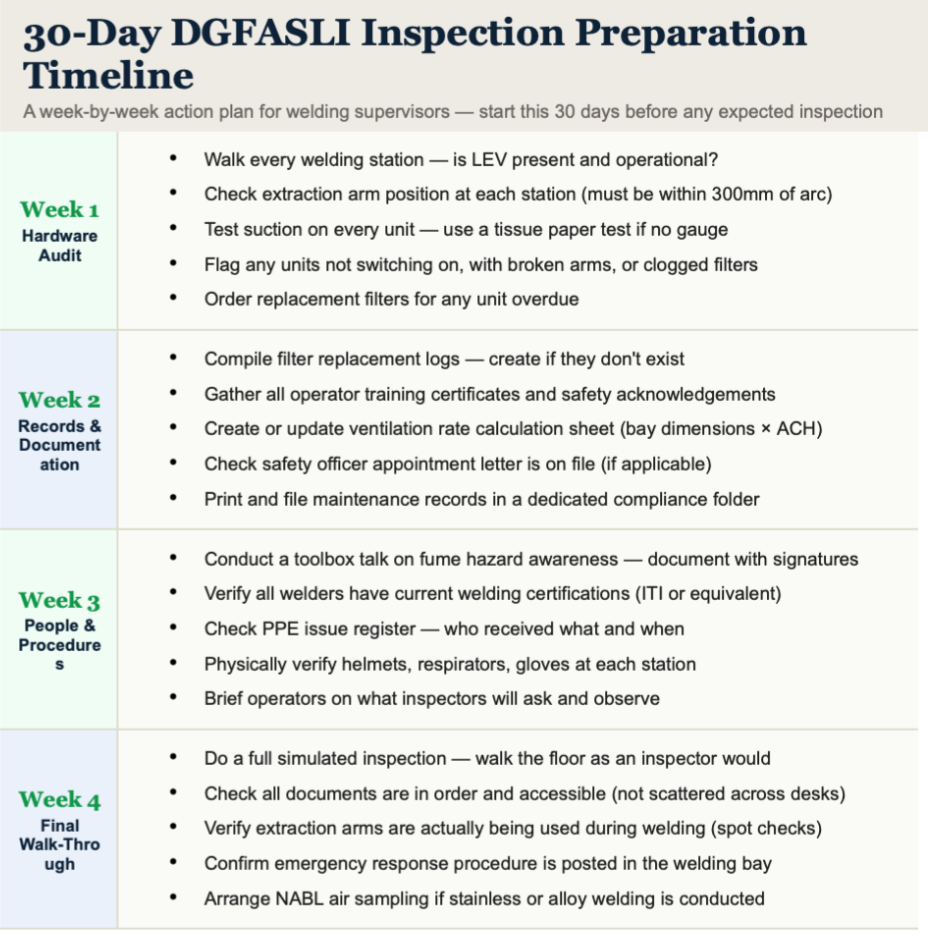
30-Day Prep Plan: What to Do Before Inspection Day

If you have reason to expect an inspection or simply want to get your welding floor into shape here is a week-by-week action plan.

30-Day Prep Plan: What to Do Before Inspection Day If you have reason to expect an inspection — or simply want to get your welding floor into shape — here is a week-by-week action plan.

Compliance is not a moment. It is a maintenance schedule, a training record, a signed log, and an extraction arm in the right position every shift, every day. Inspectors can verify all of it. The shops that pass inspections without stress are the ones that treat these as operations standards, not emergency preparations.

What Inspectors Miss — And Why That’s Not an Opportunity

In practice, DGFASLI inspections in India cover a significant amount of ground but are not exhaustive. Inspectors may not test every extraction unit’s airflow with an anemometer. They may not collect air samples on the day. They may not examine every training record in a large factory.

This leads some welding companies to conclude that partial compliance — having the hardware visible but the records thin — is a workable strategy. It isn’t, for three reasons.

First, enforcement is tightening. The OSHWC Code 2020 came into full force in November 2025 and is being actively enforced in states that previously had low inspection intensity.

Second, complaint-driven inspections are more thorough than routine ones. An injured or unwell worker who lodges a complaint triggers a targeted inspection where inspectors look specifically at hazardous process controls — and these are far less likely to result in a warning rather than prosecution.

Third, the cost of non-compliance is not just the fine. A prohibition order halts production. A prosecution complaint is a reputational event with customers and insurers. A welder with manganism or chronic lung disease is a legal liability that runs far beyond any penalty under the OSHWC Code.

The welding floor that passes inspection without stress is the one that doesn’t need to think about what the inspector will and won’t check. It is simply compliant.

Greenwich Air Filtration — DGFASLI Compliance Support

Greenwich provides free shop-floor compliance assessments for welding operations across India, covering LEV hardware audits, extraction arm positioning, filter specification, airflow verification, and documentation gap analysis.

Beyond standalone extraction systems, we also provide complete turnkey centralized welding fume exhaust solutions for your facility, from design to installation. Our scope includes airflow calculations, duct layout design, blower and filter selection, professional duct installation, and customized control panels with automation features such as VFD/PLC integration and motorized dampers.

Our FEX & DEX Series fume extractors are CPCB-compliant and designed to support the specific requirements of Indian factory inspections.

Contact our technical team to schedule a compliance visit before your next DGFASLI inspection.

#GreenwichSolutions #IndustrialAirSafety #CleanAirSolutions #FumeExtractor #OilMistCollector #DustCollector #WeldingFumeExtraction #TurnkeySolutions


Download the Brochure

Not Sure Which Machine Fits Your Process?