The wrong extraction architecture costs more than the right one in filter spend, in compliance risk, and in worker health. Here’s how to read your floor and make the call correctly.
When a welding company in India starts looking at fume extraction, the first question that typically comes up is price. The second question which should have come first is architecture. Because a portable extractor in a shop that needs centralised extraction is not half a solution. It is no solution at all: inadequate airflow, constant repositioning, overwhelmed filters, and a compliance gap that a DGFASLI inspector will not miss.
The three extraction architectures portable, Standard Fume Extractor, and centralised are not a good-better-best hierarchy. They are different tools for different floor configurations. Choosing between them correctly depends on four things: how many stations you run, how fixed your layout is, what processes you weld, and what your floor looks like in three to five years.
This guide walks through each architecture, when it works, when it doesn’t, and what a correctly designed floor looks like for small, medium, and large welding operations.
Where Does India Stand? Architecture Adoption Today
Before choosing your architecture, it helps to understand how Indian welding operations of different sizes currently use these systems and where the most common mismatches occur.
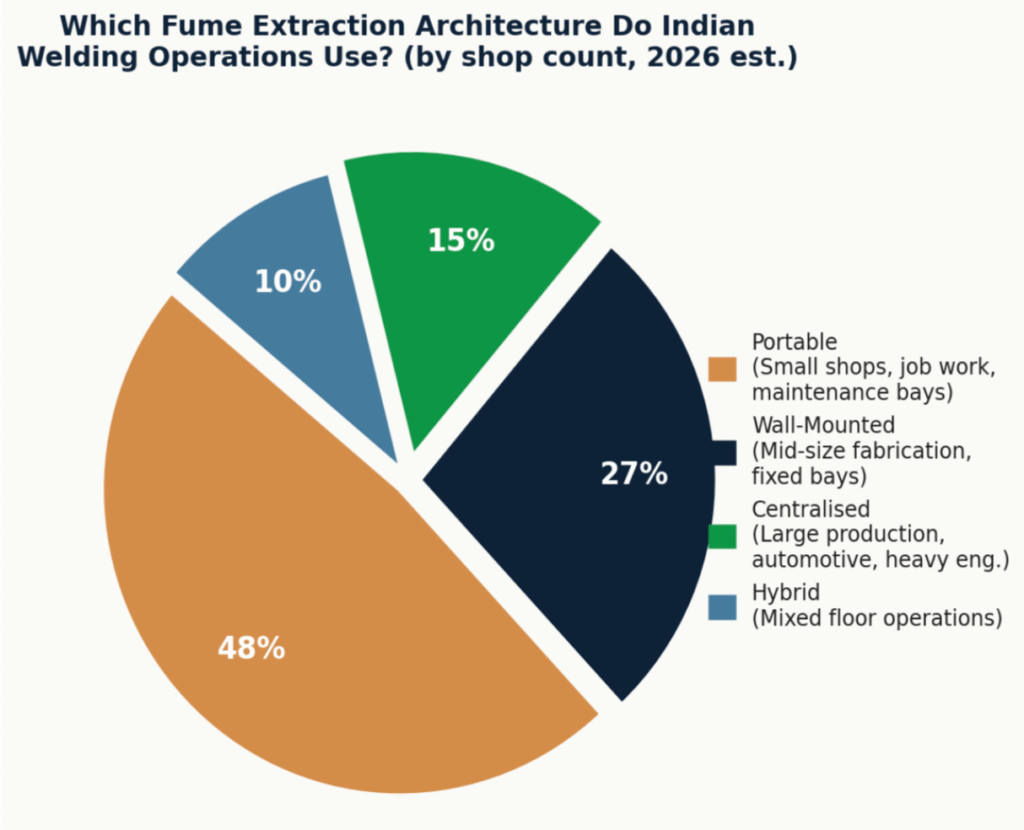
Portable extractors account for nearly half of all units in use across India primarily because the majority of India’s welding operations are small job shops and fabrication units with 2–5 stations. This is correct for those operations. The problem occurs when shops scale to 8–12 stations without upgrading the architecture, running multiple portables where a Standard or centralised system would deliver better coverage at lower total cost.
The Quick-Pick Framework
Before getting into the detail, here is the decision framework that mirrors how experienced buyers actually think through this choice:
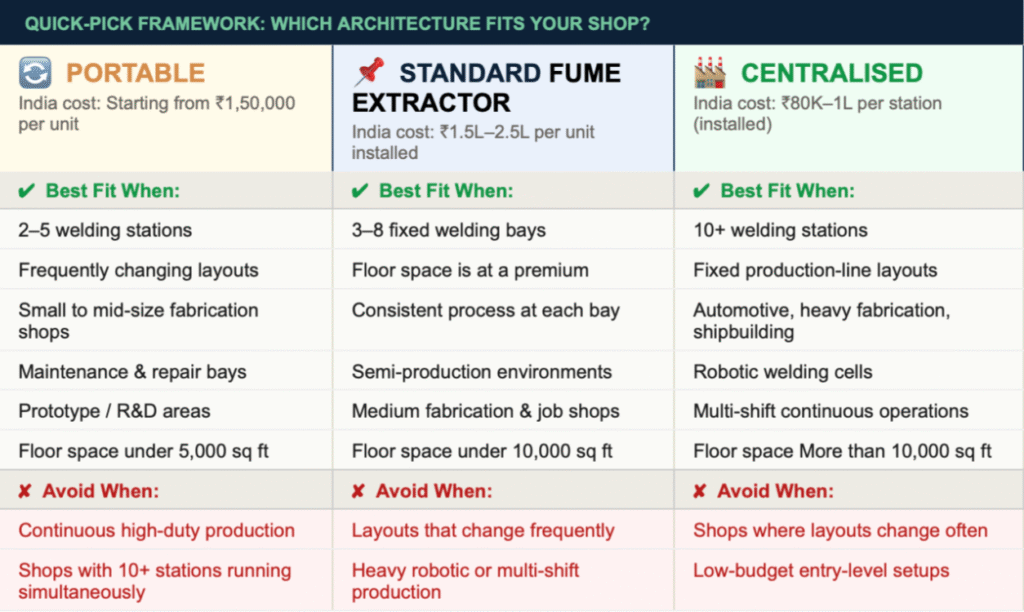
Three Shop Sizes. Three Different Answers.
Most buying mistakes happen when a shop owner applies the logic of one scenario to a different one. Here’s what each scenario actually looks like:
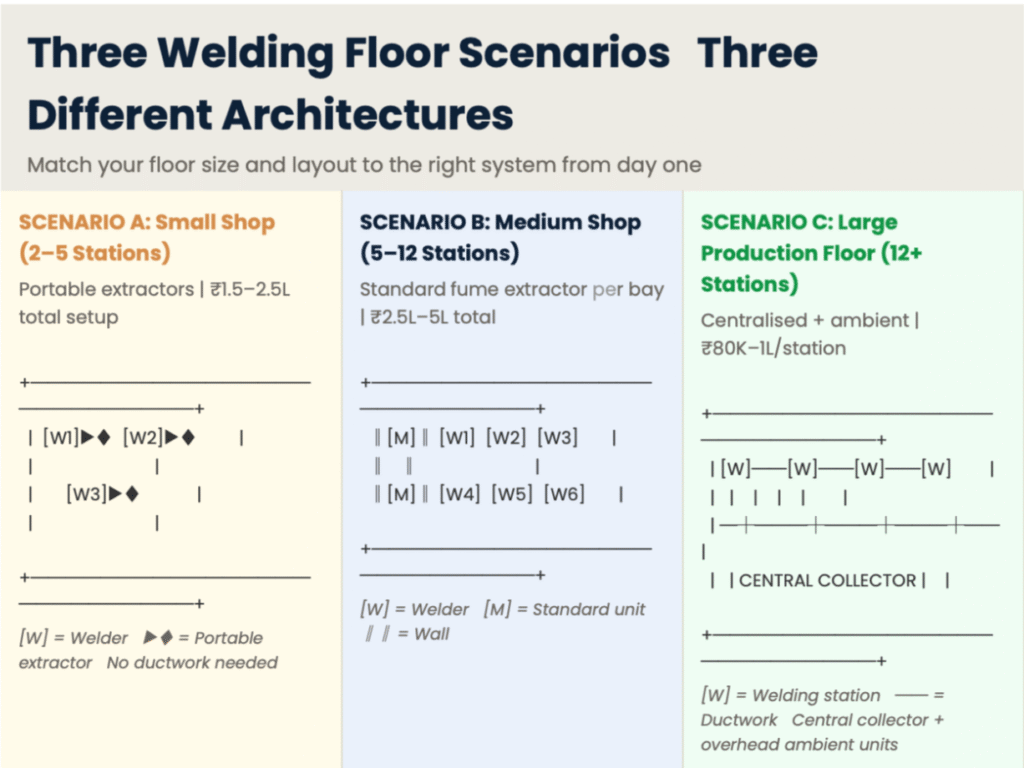
Scenario A: The Small Fabrication Shop (2–5 Stations)
A small job shop structural steel fabrication, general engineering, custom metalwork typically runs two to five welding benches with layouts that change as the work changes. Portable extractors are the right answer here, and not just for cost reasons. A fixed duct system that works perfectly for today’s bench layout becomes an obstacle when the layout changes. Portables give operators the flexibility to position extraction arms close to the arc where they need to be. Source capture at 100–150mm from the arc is the standard; a portable arm that’s repositioned correctly catches the fume before it enters the breathing zone. One that’s left in a corner does not.
Key buying consideration: CFM matters more than brand. A portable unit needs a minimum of 800–1,200 CFM with a multi-stage HEPA filter / Electrostatic Filter / cartridge Filters for standard mild steel work. For stainless steel , specify H13 or H14 HEPA / Cartridge Filters regardless of unit size.
Scenario B: The Mid-Size Shop (5–12 Stations)
A mid-size fabrication shop, structural steel contractors, pressure vessel shops, automotive component manufacturers typically have fixed welding bays with consistent processes at each bay. Standard extraction units per bay are the most cost-effective solution for this configuration. A Standard unit with one or two extraction arms services a fixed bay without consuming floor space. The practical ceiling for Standard architecture is around 8–10 bays. Beyond that, the total maintenance burden tracking filter replacement schedules across a dozen independent units starts to argue for centralisation.
A Standard unit that is correctly sized and arm-positioned will out-perform an oversized centralised system with a poorly designed duct layout. Architecture matters less than execution.
Scenario C: The Large Production Floor (12+ Stations)
A large welding floor, automotive body shops, heavy equipment fabrication, shipbuilding, robotic welding lines has a fixed layout, high-duty continuous welding, and enough stations that per-station filter costs and maintenance complexity make centralisation the only economics that work. Centralised systems use a single high-capacity collector typically 20,000 to 60,000 CFM connected via ductwork to each welding station. A single maintenance event services the whole floor. Large floors also typically need ambient background filtration layered on top of source capture ceiling-mounted recirculating units that continuously clean background air across the entire bay.
The Real Cost Comparison: 5-Year Total Ownership
Upfront price is only part of the story. Filter replacement, energy, and maintenance costs over five years often flip the economics in favour of a higher-capital architecture. Here is what the numbers look like across shop sizes:
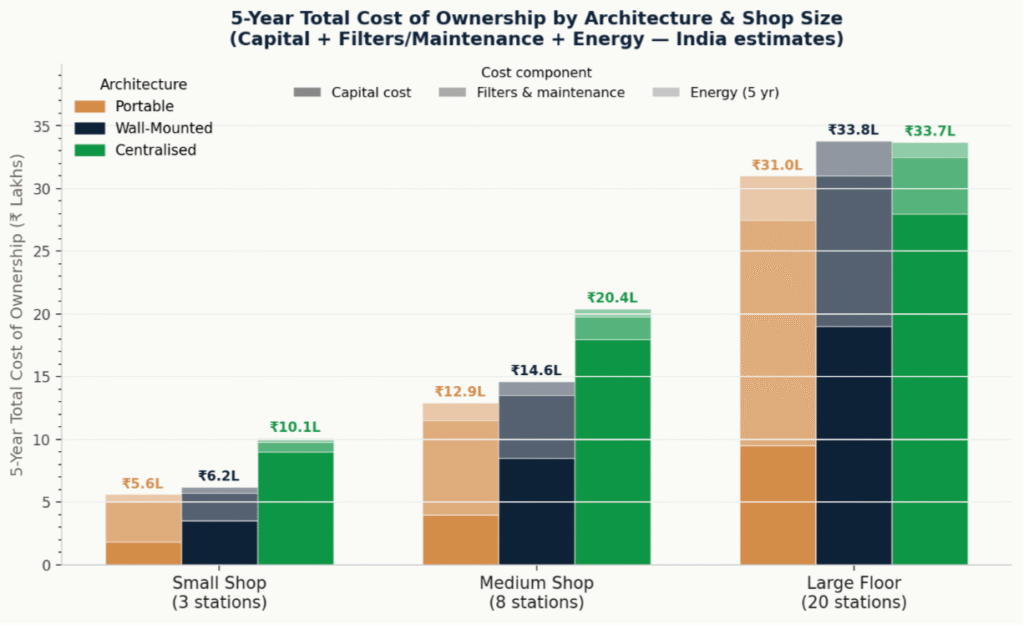
The chart makes two things clear. First, for small shops, portable is the right economic choice. The lower capital outlay and simpler maintenance more than offset the per-unit energy inefficiency. Second, at 20 stations, the centralised total cost of ownership is meaningfully lower than running 20 independent portable units, despite the higher upfront investment. The crossover point is typically around 8–10 stations depending on duty cycle and filter replacement frequency.
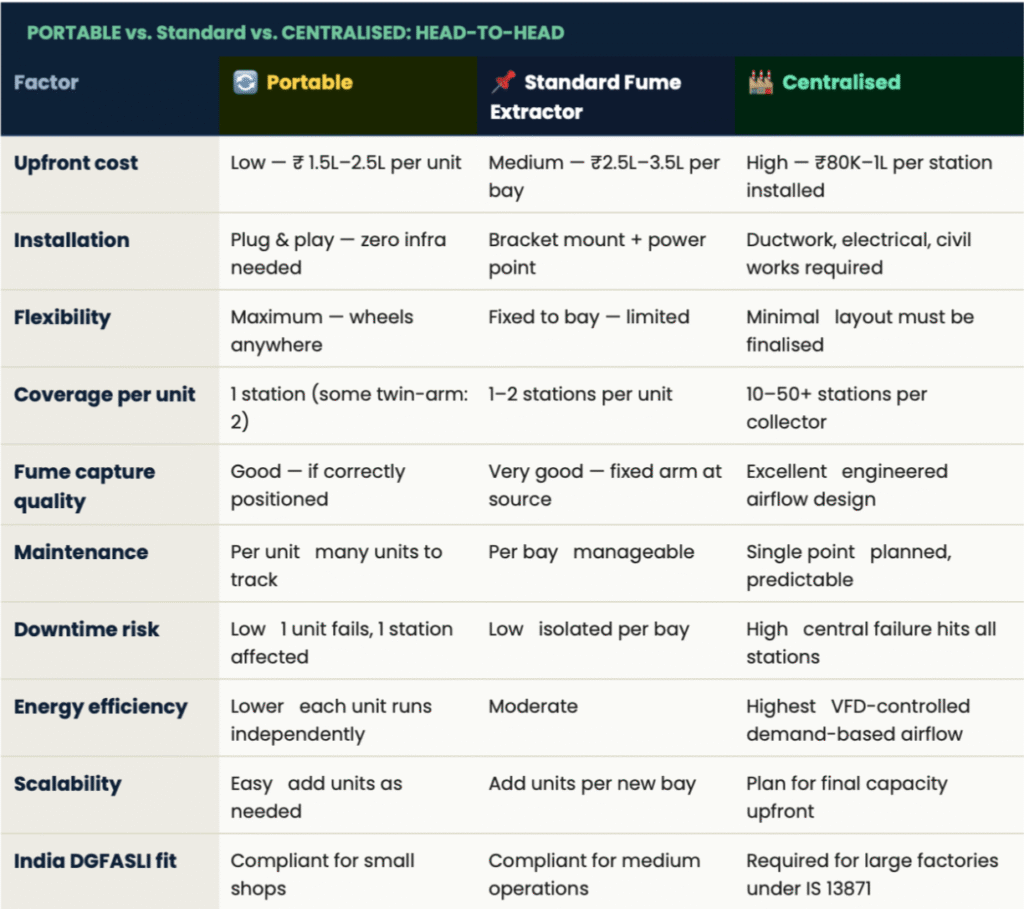
Head-to-Head: Every Factor That Matters in One Table
Here is how the three architectures compare across every decision factor a welding company actually cares about:
Why Execution Matters as Much as Architecture
Architecture selection is only half the decision. How a system is installed and operated determines whether it actually achieves DGFASLI-required fume capture levels. Here is what the data shows:
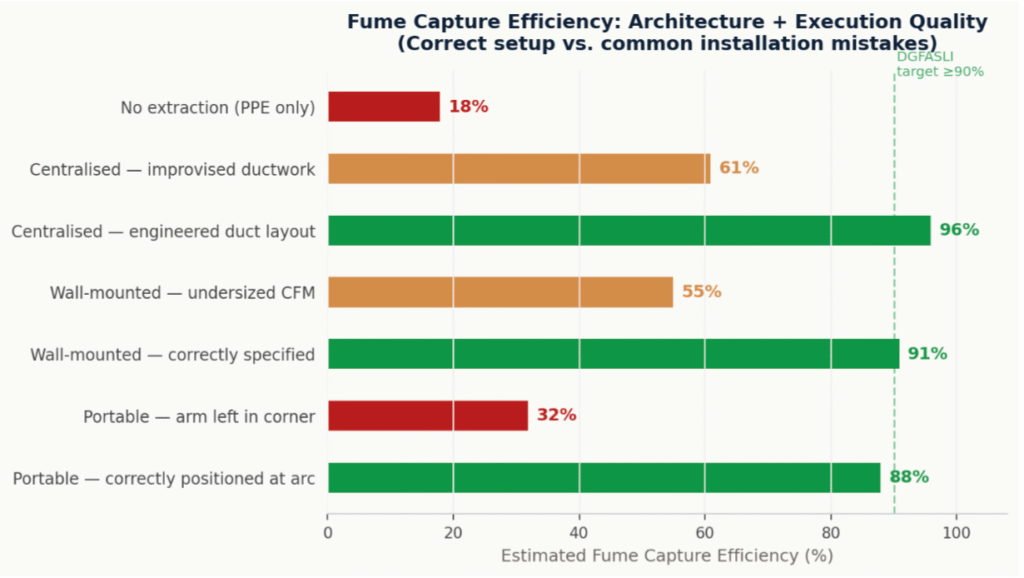
The single most important insight in this chart: a correctly positioned portable extractor (88% capture) outperforms an undersized centralised system with improvised ductwork (61%). Architecture is not a substitute for correct specification and installation. A centralised system that is properly engineered delivers 96% capture efficiency but one with poorly designed duct branches can fall below DGFASLI’s effective target of 90% while looking compliant on paper.
The Hybrid Architecture: What Most Real Floors Actually Need
Most medium-to-large Indian welding operations have multiple zones each with different processes, different layout stability, and different hazard levels. A hybrid approach with different architectures for different zones nearly always outperforms a single-architecture approach on both cost and compliance.
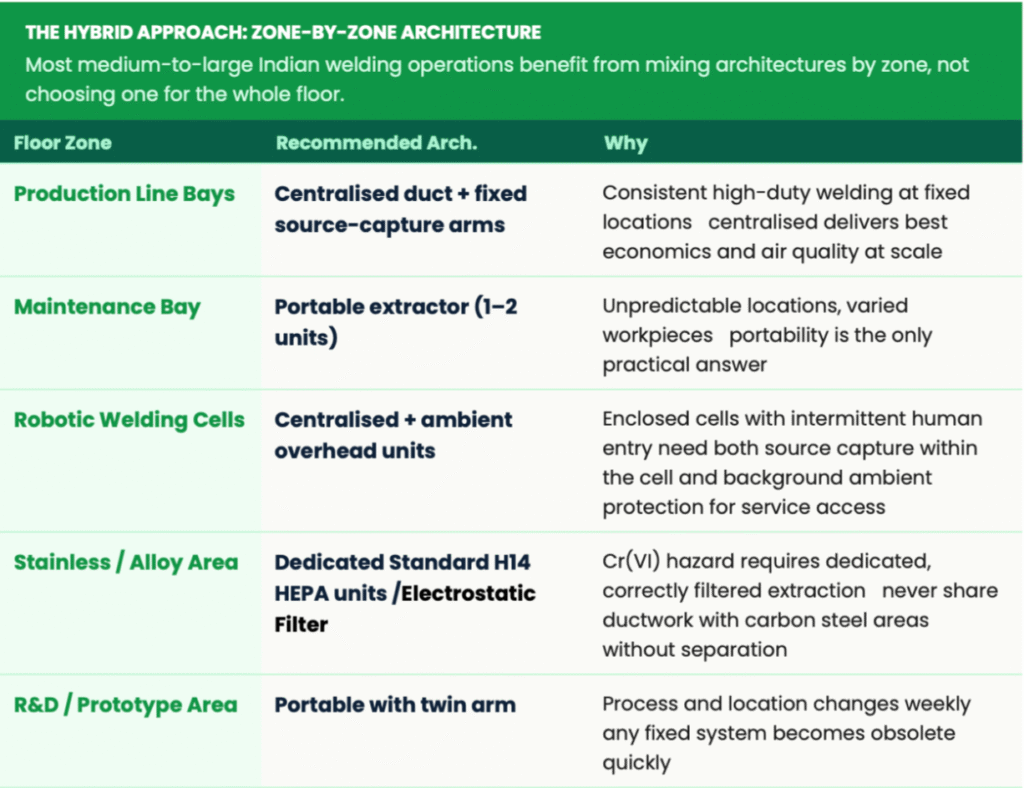
Many facilities built or expanded between 2015 and 2025 use a hybrid approach: centralised systems for fixed production lines and portable units for maintenance bays, specialty cells, or areas with unpredictable welding locations. This is not a compromise, it is correct engineering.
The Decision Checklist Before You Buy
Run through these questions before committing to any architecture:
- How many welding stations do you run simultaneously and what is that number in three years?
- Is your floor layout fixed, or does it change based on the job?
- What processes are running at each station and does any station run stainless or alloy welding?
- Do you have the electrical infrastructure and civil access for ductwork, or would installation be disruptive?
- What is your maintenance model in-house team, or must maintenance be minimal and predictable?
- Are any zones enclosed or confined robotic cells, booths that need separate extraction treatment?
Architecture first. Equipment second. The answers to these questions, not the price tag on a unit, determine which system is right for your floor.
Greenwich Air Filtration — Fume Extraction System Design
Greenwich designs portable, Standard, Standard Fume Extractor , Semi Centralized Centralised, and hybrid fume extraction systems for Indian welding operations. Our FEX & DEX Series covers all three architectures with DGFASLI and CPCB-compliant configurations. We offer free shop-floor assessments including airflow modelling, process-specific filter specification, and ductwork design before any system is sized or quoted.
#GreenwichSolutions #IndustrialAirSafety #CleanAirSolutions #FumeExtractor #DustCollector