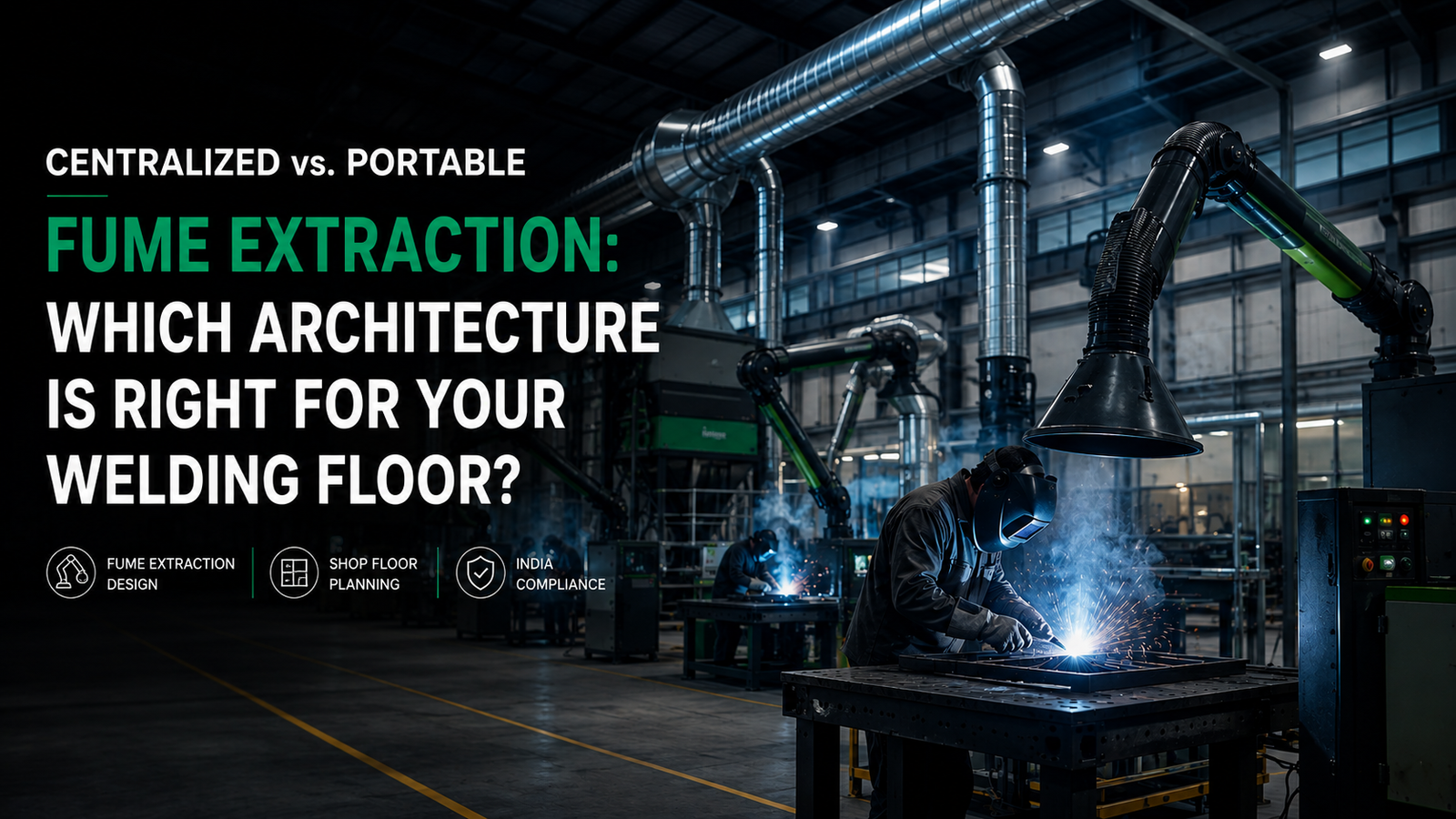
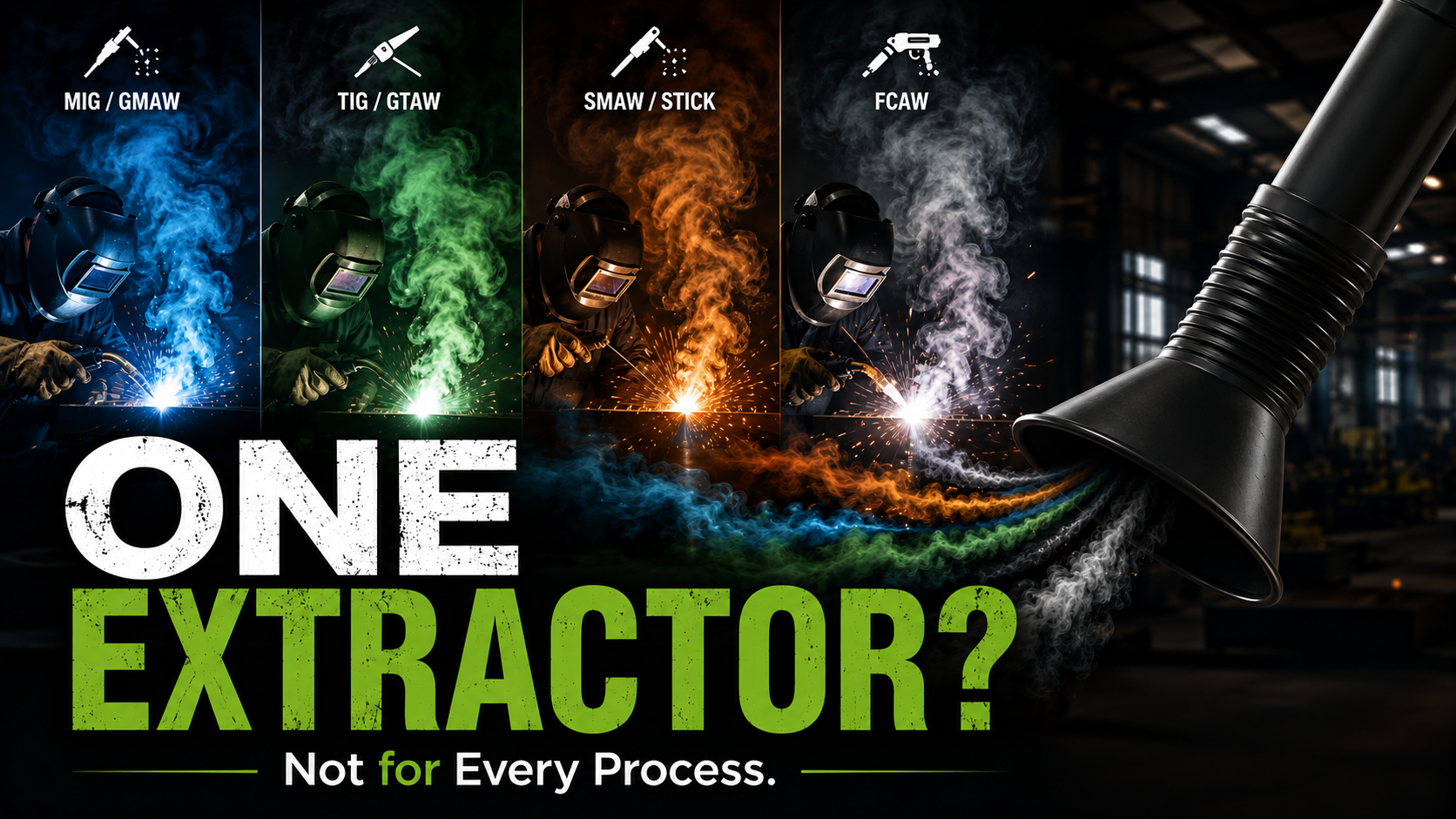
Most welding shops run more than one process. Most welding shops also run a single extractor configuration across all of them. That gap is where worker exposure and compliance risk lives.
Walk into any Indian fabrication workshop and you’ll find welders running MIG on structural steel in one bay, TIG on stainless components in another, and stick welding on heavy sections in a third. Each process generates fumes. But those fumes are not the same not in volume, not in particle size, and not in toxicity. And the extractor that handles one well may be almost useless for another.
This matters because DGFASLI inspections and CPCB guidelines don’t just ask whether you have a fume extractor. They ask whether you’ve controlled fume exposure at the source. An undersized or mismatched extractor fails that test on paper and in practice.
Here’s what every welding company operating in India needs to understand about matching fume extraction to process.
Why Process Type Determines Everything
Welding fumes are not one substance. They are complex mixtures of metallic oxides, particulate matter, gases, and in some cases, known carcinogens. The composition and therefore the hazard level and filtration requirement changes dramatically depending on what you’re welding, what consumables you’re using, and how you’re doing it.
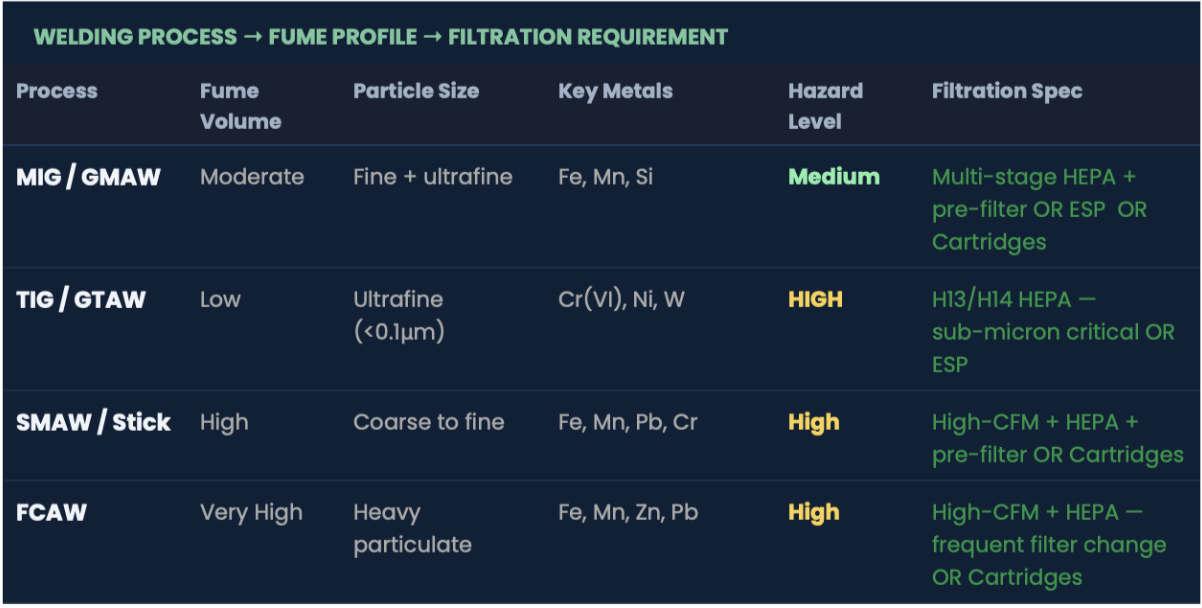
The most critical distinction is between processes that generate high volumes of fumes and those that generate lower volumes but contain highly toxic contaminants. TIG welding is the clearest example. It produces relatively little visible smoke, leading many welding shops to assume it is a low-risk process. It is not.
When used on stainless steel, TIG welding generates hexavalent chromium, a Group 1 IARC carcinogen, in ultrafine particles that can penetrate deep into the pulmonary region of the lungs. A standard pre-filter cannot capture these particles effectively. Only an H13 or H14-rated HEPA filter, an ESP combination system, or a cartridge filtration system can capture them reliably.
Low visible fume does not mean low hazard. TIG on stainless produces hexavalent chromium in particles small enough to reach the deepest part of the lung. It is the most underestimated exposure risk on the welding floor.
The 4 Filtration Technologies and When Each One Is Right
No single filter technology handles everything. Effective fume extraction in a serious welding operation is a multi-stage system, where each layer does a specific job. Understanding what each technology does and critically, what it misses is the foundation of a correctly specified extractor.
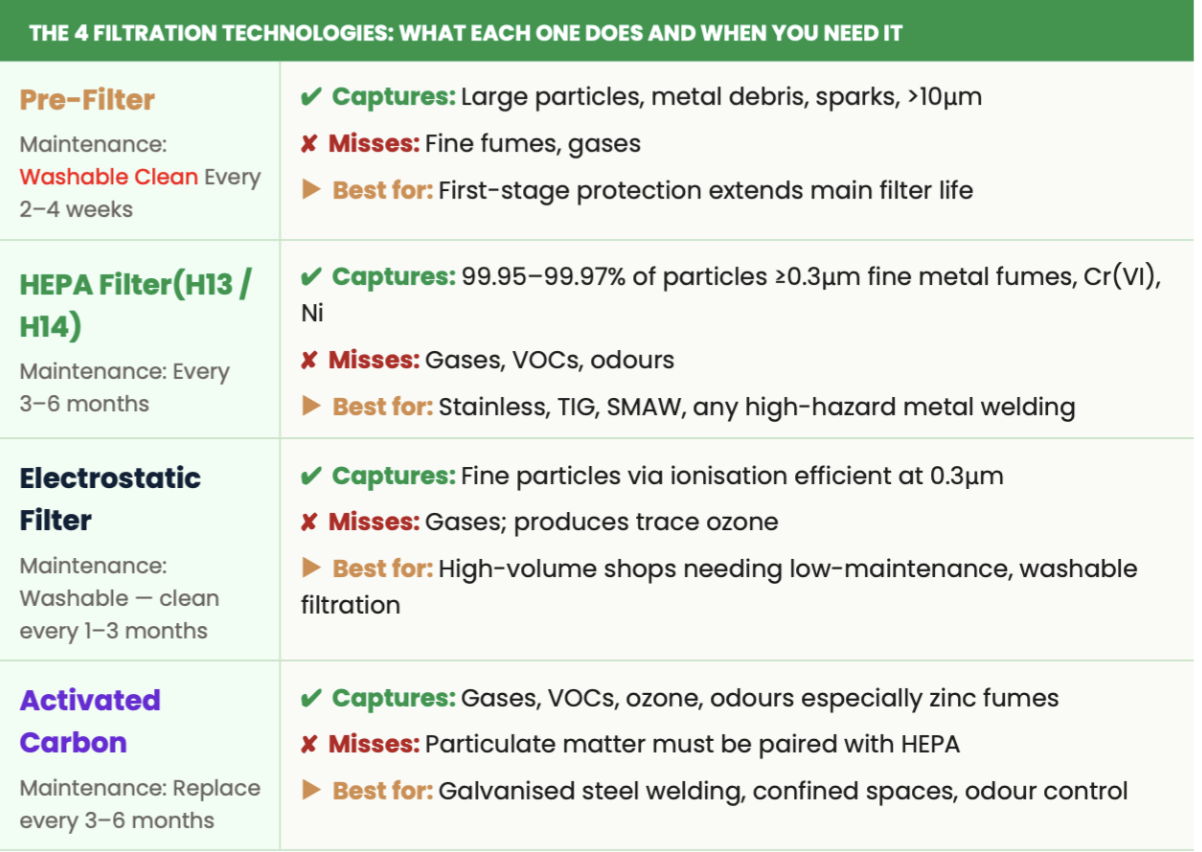
The sequencing of filtration stages is just as important as the technology itself. A HEPA filter installed without an upstream pre-filter will clog quickly, reducing its service life, increasing replacement costs, and creating potential compliance gaps. Similarly, an activated carbon layer used without effective particulate filtration can control gases and odours but allows fine metal fumes to pass through.
Multi-stage filtration systems are effective because each stage protects and enhances the performance of the next. An ESP combination system, consisting of a pre-filter, aluminium wire mesh, ESP module, and activated carbon filter, delivers excellent filtration for applications involving both particulate matter and gaseous contaminants. For welding applications, cartridge filtration remains one of the most effective technologies, offering high-efficiency capture across virtually all types of welding fumes.
India’s Compliance Framework: What the Law Actually Requires
The regulatory environment around welding fume in India has tightened significantly under the OSHWC Code 2020 and updated CPCB guidelines. The key shift: the burden of proof has moved from ‘we have ventilation’ to ‘we have controlled exposure at the source.’ That is a meaningful difference in what inspectors look for.
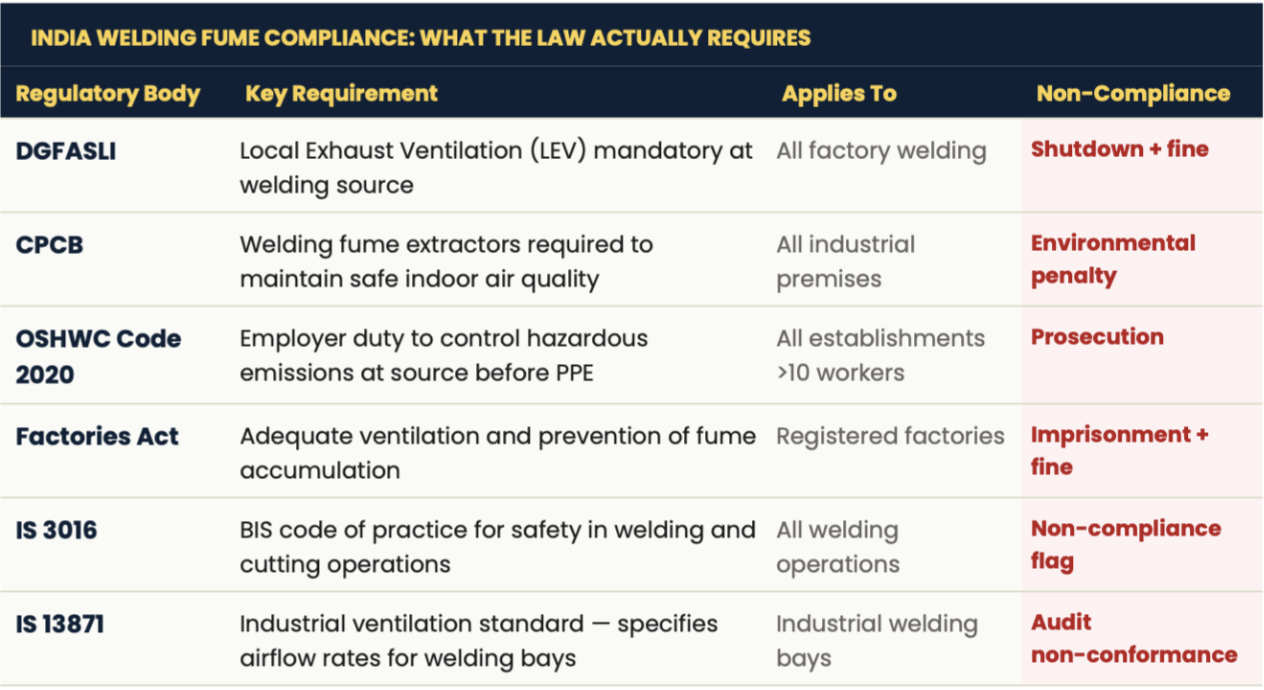
Two standards deserve particular attention for welding operations. IS 3016, the BIS Code of Practice for Welding Safety, specifies that fume control should follow the hierarchy of controls, prioritising engineering controls, such as source extraction, before administrative controls, such as job rotation, and personal protective equipment (PPE), including respirators. This hierarchy is critical. If respirators are your primary means of controlling welding fumes, you are not meeting the intent of the standard, even if every welder is wearing one.
IS 13871, the industrial ventilation standard, specifies the minimum ventilation requirements for welding areas. For stainless steel and alloy welding involving chromium or nickel, higher ventilation rates are required due to the increased health risks. The standard also recommends source capture extraction as the preferred control measure, rather than relying solely on general dilution ventilation.
Getting the Sizing Right: A Calculation Most Shops Get Wrong
The most common extractor failure in Indian welding shops isn’t a broken unit. It’s an undersized one. A unit that can’t generate sufficient airflow at the arc simply doesn’t capture the fume at the source it disperses it into the breathing zone instead. Here’s how to size correctly:
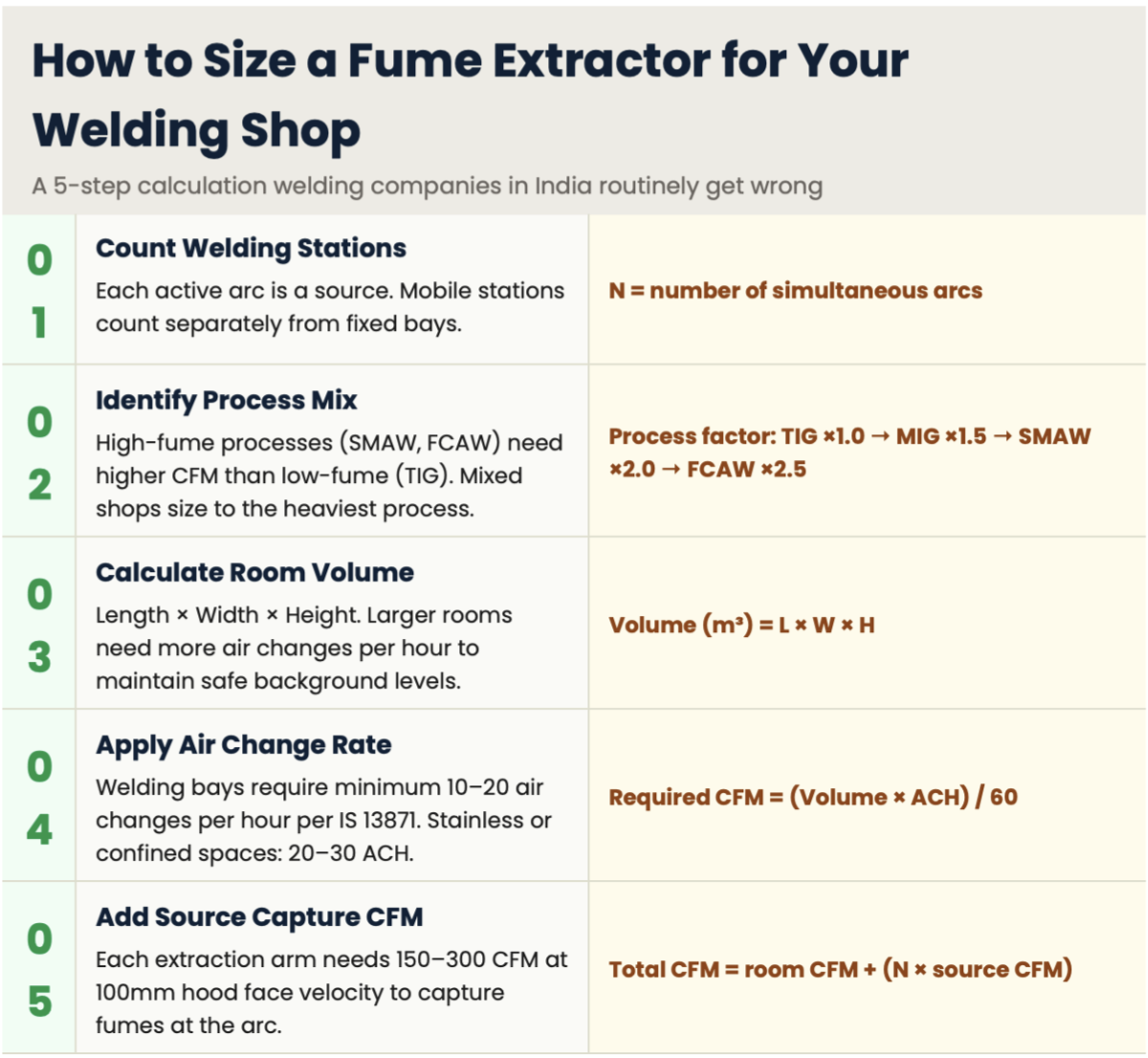
One practical note: for shops running mixed processes, always size to the highest-hazard process in the bay not the average. If one station runs FCAW and another runs TIG, the FCAW process drives the CFM specification. The TIG station benefits from the headroom; the FCAW station is properly covered.
The Bottom Line for Welding Companies
A one-size-fits-all approach to fume extraction is a false economy. The cost of an incorrectly specified extraction system compounds over time through higher filter replacement costs as filters clog faster than intended, increased absenteeism and health-related liabilities, and compliance failures that can result in significant legal and financial consequences under India’s evolving regulatory framework.
The right approach is to specify the filtration system based on the welding process and the contaminants generated:
- MIG Welding (Mild Steel): ESP combination systems with a pre-filter, cartridge filters, or multi-stage HEPA systems with a high-airflow pre-filter and source capture arm are all effective solutions.
- TIG Welding (Stainless Steel): Cartridge filtration is the preferred solution. Alternatively, a multi-stage system with an H13 or H14 HEPA filter is essential for capturing hexavalent chromium (Cr(VI)) particles. An ESP combination system consisting of a pre-filter, ESP module, and activated carbon filter can also be used, but an ESP alone is not sufficient for Cr(VI).
- SMAW / FCAW: High-CFM extraction systems with robust pre-filtration are recommended. Suitable options include ESP combination systems, cartridge filters, or multi-stage HEPA filtration, supported by a proactive filter maintenance schedule.
- Galvanised Steel Welding: Cartridge filtration or HEPA filtration combined with activated carbon is recommended to effectively capture zinc oxide fumes and reduce the risk of metal fume fever.
- Mixed Welding Shops: Use process-specific extraction systems rather than a single ambient unit. Zone-specific extraction arms paired with the appropriate filtration technology, whether ESP combination, cartridge, or multi-stage HEPA, provide significantly better protection and performance.
The question is not whether your welding shop has fume extraction. The question is whether it has the right extraction for every process running on your floor. Those are different questions with different answers.
About Greenwich Air Filtration
Greenwich designs and manufactures industrial air filtration systems for welding, dust collection, and oil mist control applications. Our FEX & DEX Series Fume Extractors are engineered for process-specific performance available in portable, wall-mounted, and centralised configurations for Indian industrial facilities. Contact our technical team for a free shop assessment and extractor sizing consultation.