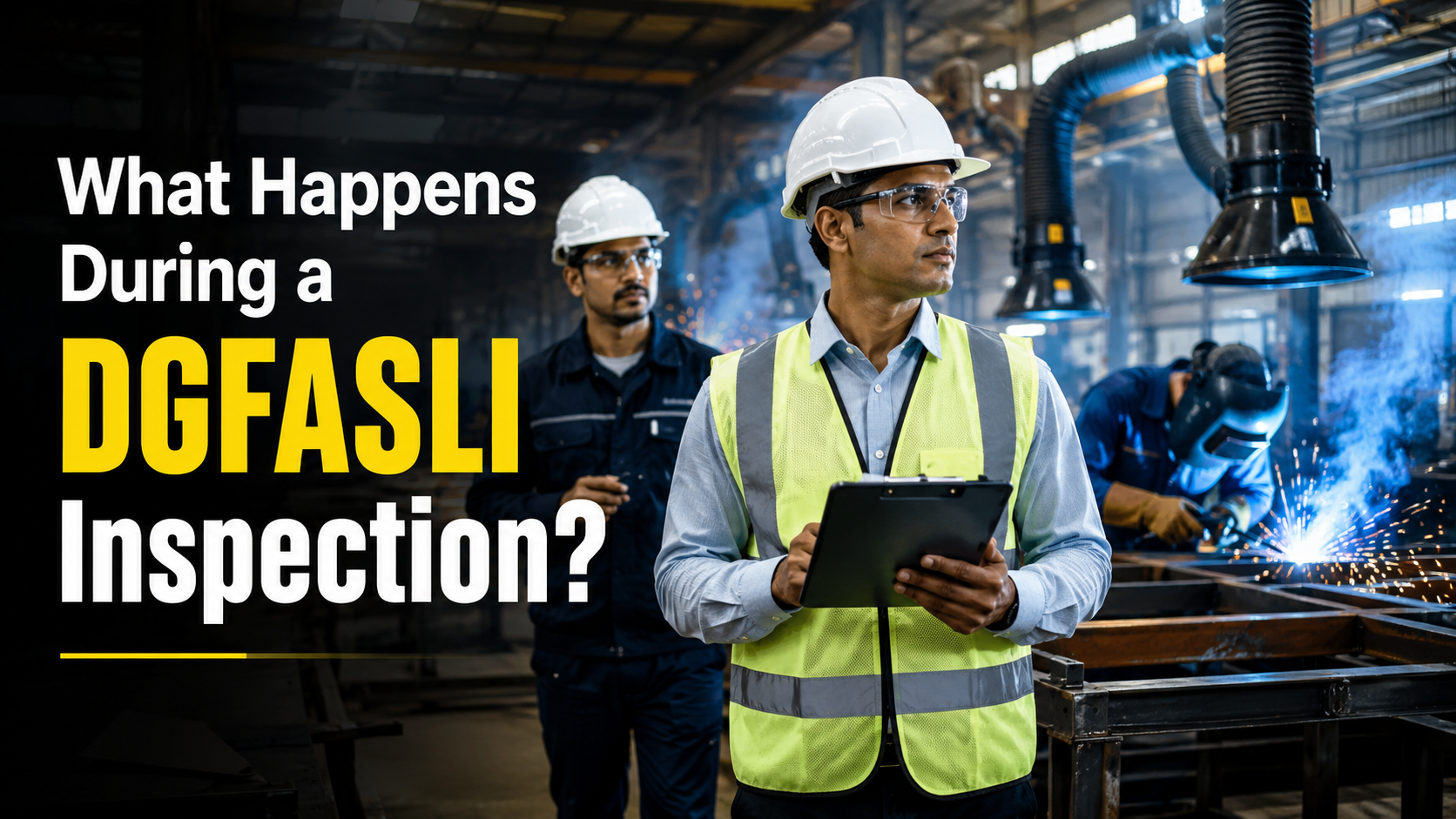
An inspector doesn’t just check whether you have a fume extractor. They check whether it works, whether it’s positioned correctly, whether the filters were changed on time, and whether you can prove it. Here’s what actually happens on inspection day.
Most welding companies in India know three things about DGFASLI: it stands for something to do with factories, it can inspect your facility, and you need a fume extractor to be compliant. That knowledge covers roughly 20% of what an inspector actually looks at.
The other 80% the records, the documentation, the operator training logs, the ventilation calculations, the PPE registers is where the majority of violations are found. A welding shop with a functioning extractor at every station has still received prohibition orders because the filter replacement log was missing or the workers couldn’t demonstrate they’d been trained on fume hazards.
Note on naming: DGFASLI was officially renamed the Directorate General of Occupational Safety and Health (DGOSH) under the OSHWC Code 2020, which came into force on 21 November 2025. Most industry references and state enforcement agencies still use DGFASLI. This guide uses both terms interchangeably.
This guide is written for the welding supervisor or HSE manager who wants to know exactly what happens when an inspector walks through the door and what needs to be in order before that day arrives.
First: What DGFASLI Actually Has Authority to Do
Understanding the inspector’s powers matters because it shapes what you need to have ready not just on the floor, but on paper.
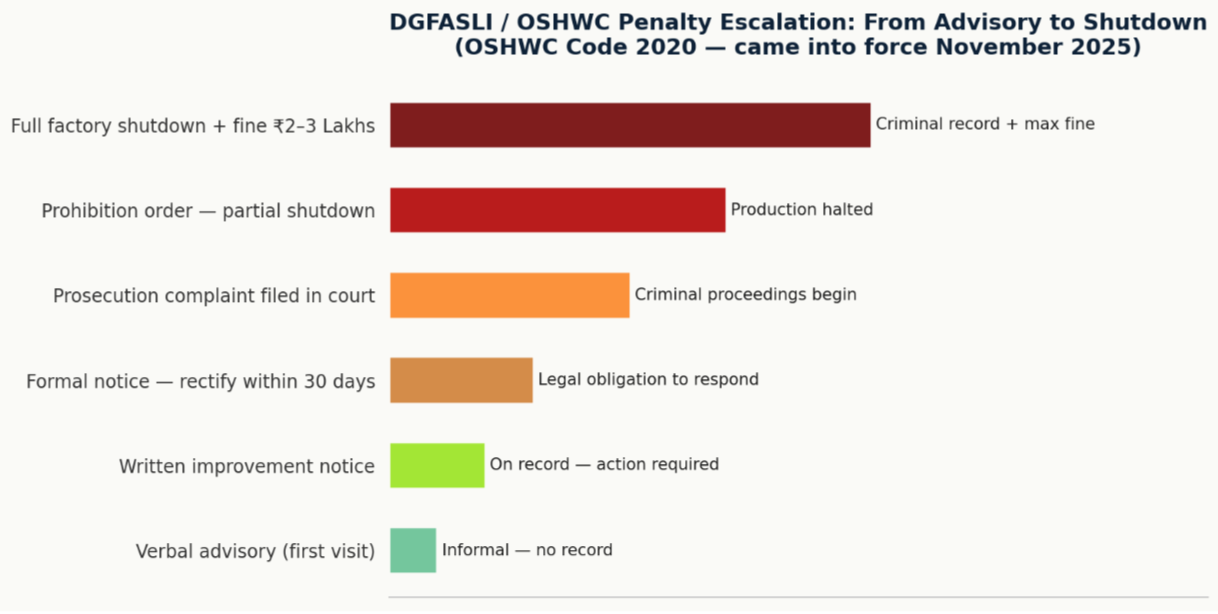
Inspection authority: Inspectors under the OSHWC Code 2020 can enter any registered factory without prior notice. They can examine workers, review records, take samples of materials, and test equipment. They do not need to give advance warning.
Prohibition orders: If an inspector finds conditions that pose immediate danger to worker health, they can issue an on-the-spot prohibition order halting specific operations without going to court first. This is the scenario welding companies fear most, and it is entirely preventable.
Prosecution: For non-compliance with the OSHWC Code, penalties run from ₹2 lakh to ₹3 lakh per violation. Falsification of records such as backdating filter replacement logs or forging training signatures is treated as a criminal offence with imprisonment provisions.
What Inspectors Actually Check: The Real Sequence
Based on DGFASLI advisory guidelines, OSHWC Code 2020 enforcement patterns, and IS 3016 / IS 13871 requirements, here is what a welding floor inspection actually involves in the order inspectors typically work through it.
Stop 1: The Reception Desk — Before They Even Enter the Floor
Inspectors typically request these documents on arrival, before walking the shop:
- Factory registration certificate and current licence under OSHWC Code 2020
- Safety officer appointment letter (mandatory for factories with 500+ workers)
- Last inspection report and actions taken
- Accident register (Form 26 under previous Factories Act — equivalent under OSHWC)
- Workers’ health examination records (mandatory for workers in hazardous processes)
If these aren’t at the reception desk in an organised file, you’ve already started poorly. Inspectors take note of document readiness as an indicator of overall compliance culture.
Stop 2: The Welding Bay — Hardware First
The first physical check is hardware — what’s installed, where it’s positioned, and whether it’s actually running. The single most common immediate violation: an extractor that is present but not positioned correctly.
| An extraction arm hanging in the corner three metres from the arc is not compliance. It is furniture. The CPCB mandate for local exhaust ventilation means capture at the source — within 300mm of the welding arc. Distance is the variable most shops get wrong |
Inspectors specifically look for:
- Is the extractor switched on during active welding — or switched off to reduce noise?
- Is the extraction arm positioned close enough to the arc to create visible fume capture?
- Is there any visible fume escaping into the welder’s breathing zone?
- Are there bypass valves, blocked ports, or disconnected ducts on any unit?
- Is there a spark arrestor fitted where processes generate sparks?
Stop 3: Stainless Steel and Alloy Welding Stations — Separate and Stricter
If your facility welds stainless steel, high-chromium alloys, or nickel-based materials, expect a separate and more detailed check at those stations. Cr(VI) — hexavalent chromium — is a Group 1 carcinogen under IARC classification. CPCB has specific guidelines for Cr(VI) exposure that go beyond standard fume extraction requirements:
- NABL-accredited air sampling results are expected on file — not just hardware presence
- H13 or H14 HEPA filtration ,ESP Filtration & Cartridge Filtration is effectively required — standard filters are inadequate for Cr(VI)
- Separate extraction circuit recommended — mixing stainless station ducts with carbon steel stations contaminates the carbon steel station’s exhaust with Cr(VI)
- Respirators at stainless stations must be minimum FFP3 / P3 grade — not standard welding shields
The Common Violations: What Actually Gets Flagged
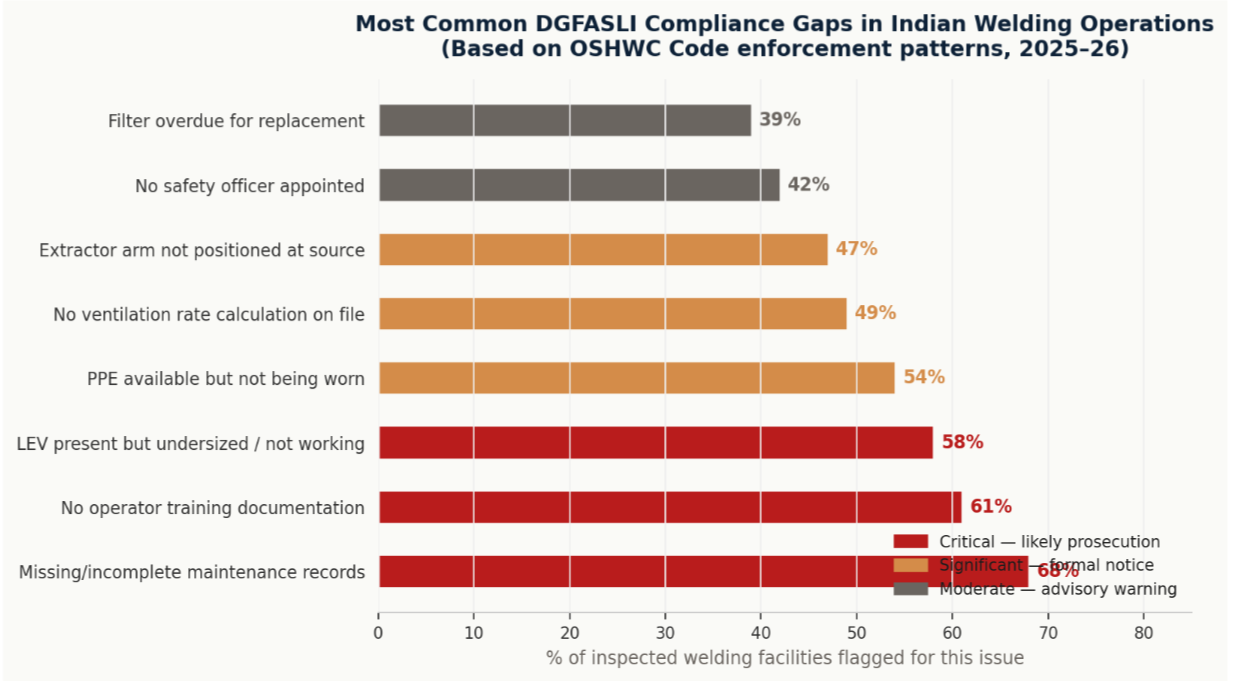
The most frequent finding is not missing hardware — it’s missing records. A shop can have a functioning extractor at every station and still fail an inspection because it cannot produce a filter replacement log, a training record, or a ventilation rate calculation.
The ‘it exists’ trap: Many welding companies believe that having PPE available means they are compliant. Inspectors check whether it’s being used, whether it was issued (register), whether it’s in serviceable condition, and whether workers have been trained on its correct use. Having 10 helmets in a cupboard satisfies none of those four checks.
What Gets You Shut Down: The Red Lines
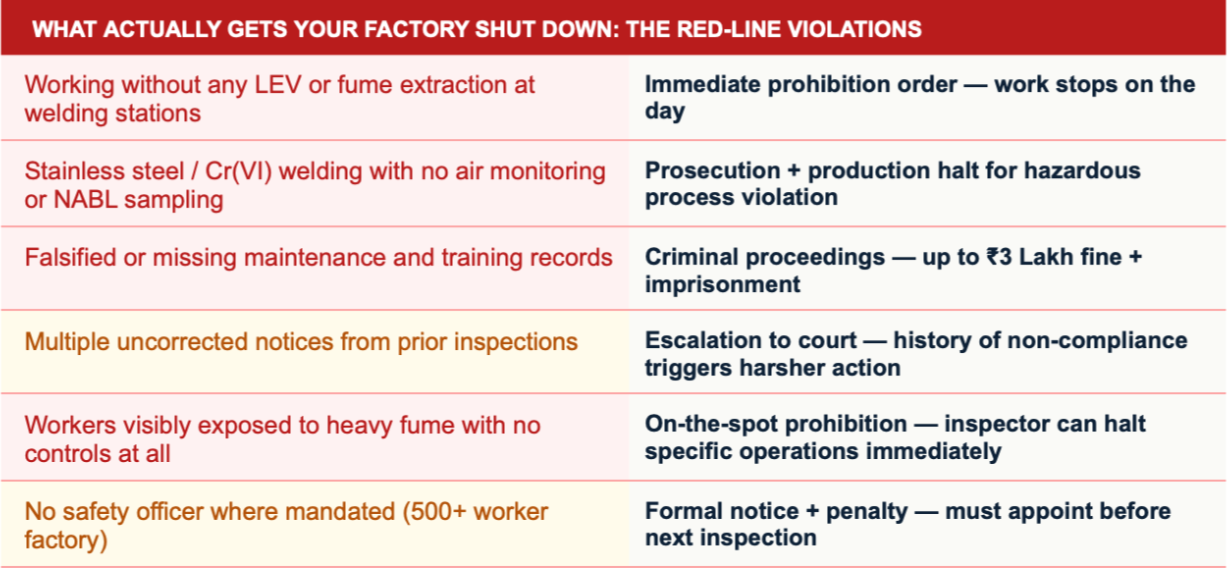
The prohibition order is the outcome every welding company wants to avoid. The important thing to understand is that inspectors do not want to shut factories they want compliance. First-time violations where the employer shows willingness to correct typically result in a written notice with a 30-day rectification window. The escalation to shutdown happens when violations are repeated, when records are falsified, or when the inspector judges that immediate danger to workers exists.
The Compliance Readiness Check: Where Does Your Shop Stand?
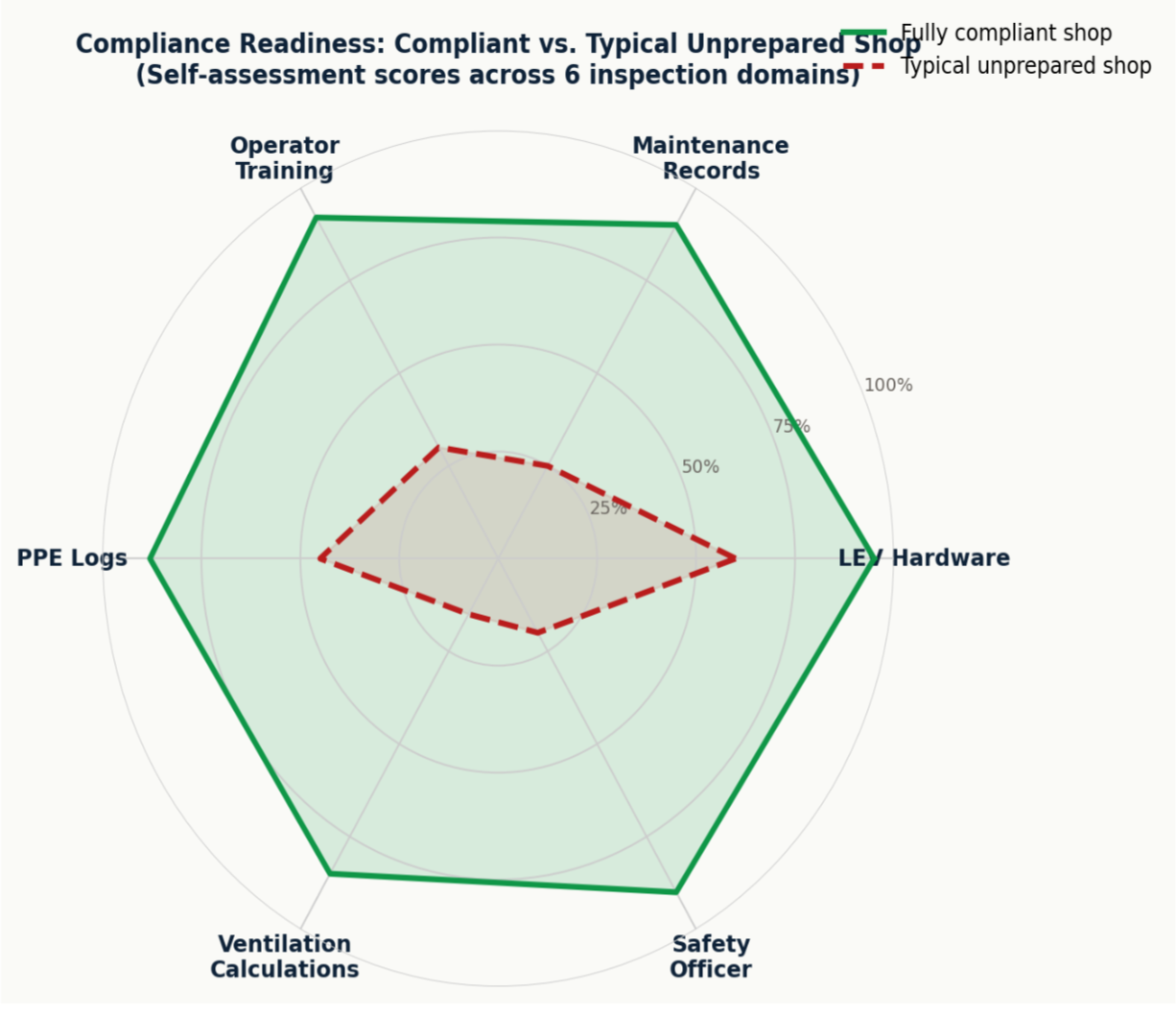
The radar chart shows where the compliance gap typically lives. Hardware LEV presence scores reasonably in most shops. The severe gaps are in maintenance records, operator training documentation, and ventilation calculations the paper trail that proves the hardware is working correctly and consistently.
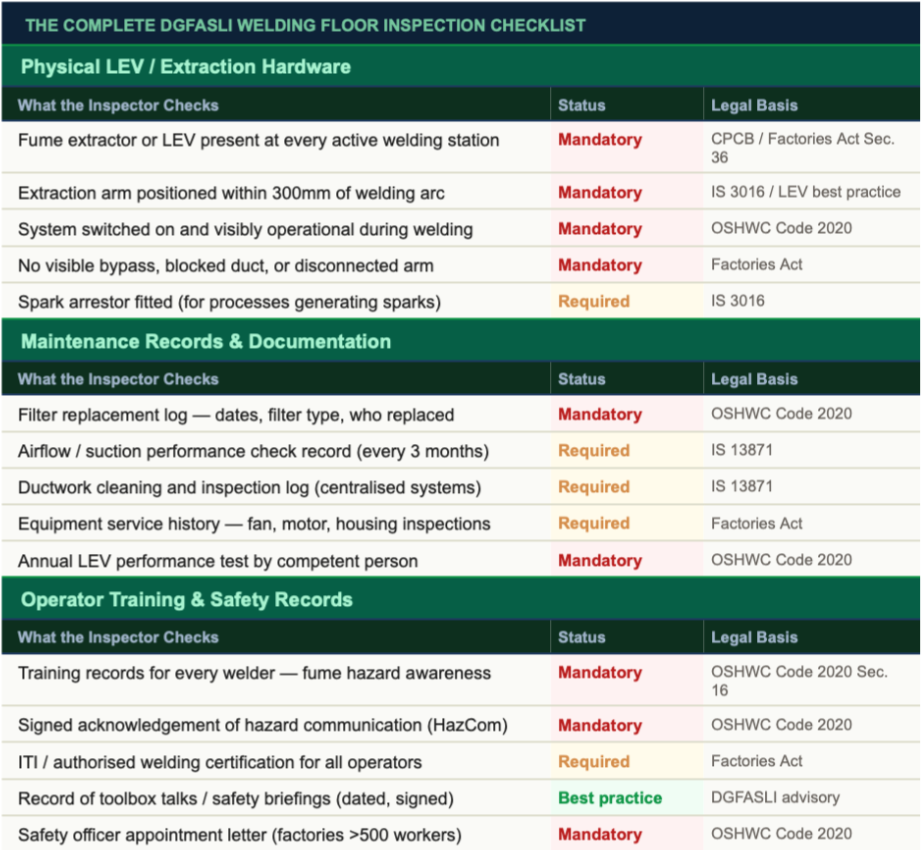
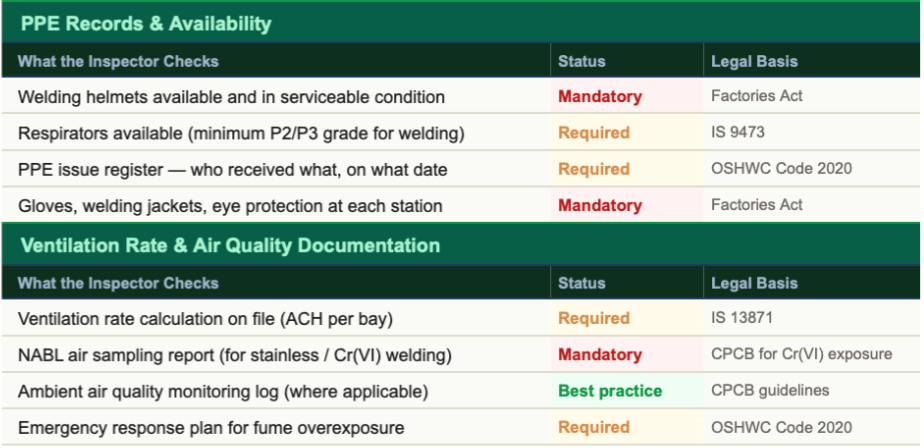
The Complete Inspection Checklist
Use this against your own floor before an inspector does. Every row marked Mandatory carries legal weight under the OSHWC Code 2020 or the Factories Act (where OSHWC transition rules still apply).
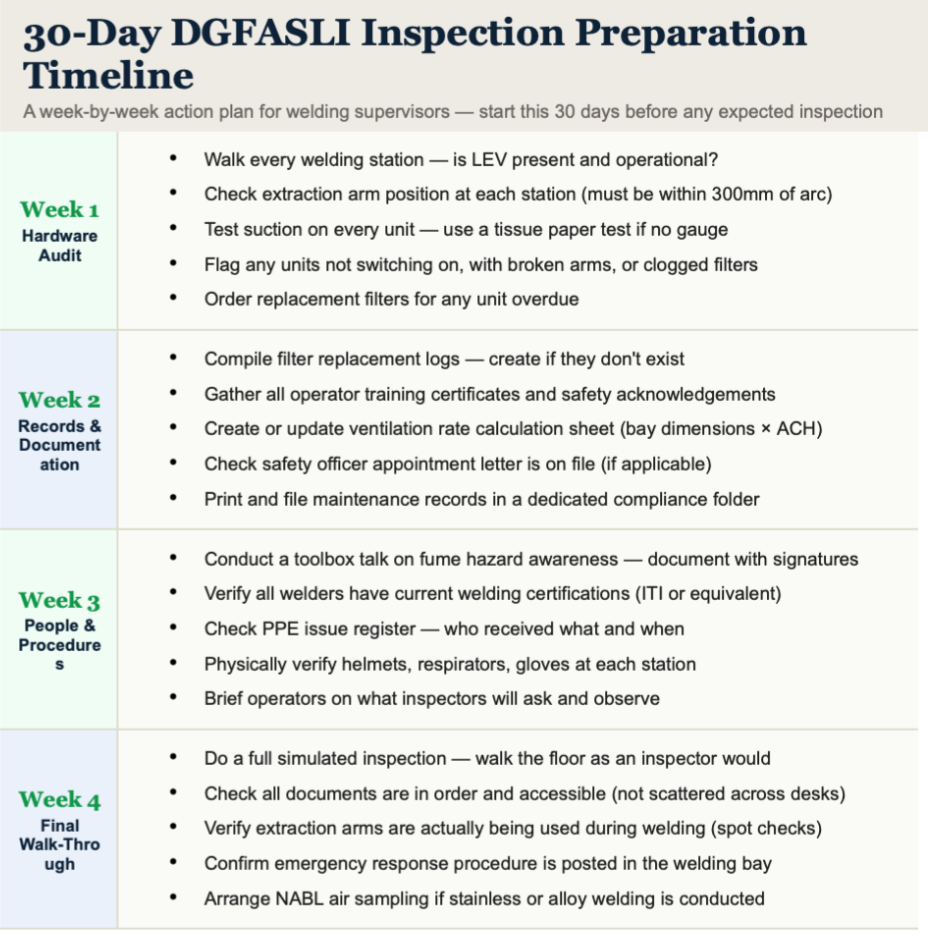
30-Day Prep Plan: What to Do Before Inspection Day
If you have reason to expect an inspection or simply want to get your welding floor into shape here is a week-by-week action plan.
Compliance is not a moment. It is a maintenance schedule, a training record, a signed log, and an extraction arm in the right position every shift, every day. Inspectors can verify all of it. The shops that pass inspections without stress are the ones that treat these as operations standards, not emergency preparations.
What Inspectors Miss — And Why That’s Not an Opportunity
In practice, DGFASLI inspections in India cover a significant amount of ground but are not exhaustive. Inspectors may not test every extraction unit’s airflow with an anemometer. They may not collect air samples on the day. They may not examine every training record in a large factory.
This leads some welding companies to conclude that partial compliance — having the hardware visible but the records thin — is a workable strategy. It isn’t, for three reasons.
First, enforcement is tightening. The OSHWC Code 2020 came into full force in November 2025 and is being actively enforced in states that previously had low inspection intensity.
Second, complaint-driven inspections are more thorough than routine ones. An injured or unwell worker who lodges a complaint triggers a targeted inspection where inspectors look specifically at hazardous process controls — and these are far less likely to result in a warning rather than prosecution.
Third, the cost of non-compliance is not just the fine. A prohibition order halts production. A prosecution complaint is a reputational event with customers and insurers. A welder with manganism or chronic lung disease is a legal liability that runs far beyond any penalty under the OSHWC Code.
The welding floor that passes inspection without stress is the one that doesn’t need to think about what the inspector will and won’t check. It is simply compliant.
Greenwich Air Filtration — DGFASLI Compliance Support
Greenwich provides free shop-floor compliance assessments for welding operations across India, covering LEV hardware audits, extraction arm positioning, filter specification, airflow verification, and documentation gap analysis.
Beyond standalone extraction systems, we also provide complete turnkey centralized welding fume exhaust solutions for your facility, from design to installation. Our scope includes airflow calculations, duct layout design, blower and filter selection, professional duct installation, and customized control panels with automation features such as VFD/PLC integration and motorized dampers.
Our FEX & DEX Series fume extractors are CPCB-compliant and designed to support the specific requirements of Indian factory inspections.
Contact our technical team to schedule a compliance visit before your next DGFASLI inspection.
#GreenwichSolutions #IndustrialAirSafety #CleanAirSolutions #FumeExtractor #OilMistCollector #DustCollector #WeldingFumeExtraction #TurnkeySolutions