Electrostatic Precipitator (ESP): Industrial Air Filtration Technology for Cleaner Air
Industrial facilities often generate smoke, welding fumes, oil mist, and fine particulate matter during daily operations. If these airborne contaminants are not controlled, they can affect worker health, reduce equipment life, and increase compliance risk.
An Electrostatic Precipitator, or ESP, is one of the most effective solutions for removing these pollutants. Unlike conventional filters that depend on dense media, ESP systems use electrical charge to capture fine and sub-micron particles while maintaining low airflow resistance.
Greenwich ESP systems are designed for industrial air filtration in manufacturing environments where performance, easier maintenance, and long service life matter.
WHAT IS AN ELECTROSTATIC PRECIPITATOR?
An Electrostatic Precipitator is an industrial air filtration system that removes smoke, fumes, oil mist, and fine particulate matter from air streams using electrostatic charge.
Instead of trapping contaminants in disposable filter media, an ESP charges airborne particles and collects them on metal plates. This makes the system especially effective for applications involving fine particles and continuous industrial use.
Industries that commonly use ESP filtration:
– Welding and fabrication
– Metalworking plants
– CNC machining operations
– Pharmaceutical manufacturing
– Food processing
– Plastic and rubber manufacturing
HOW DOES AN ELECTROSTATIC PRECIPITATOR WORK?
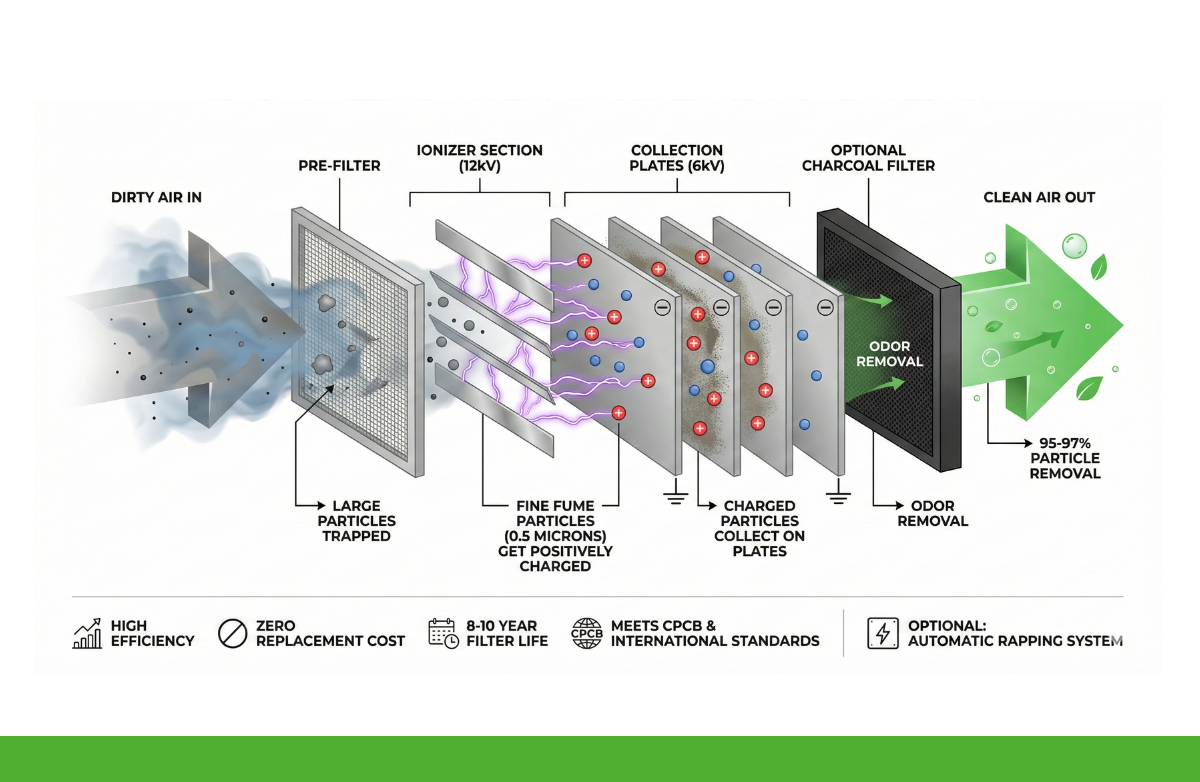
ESP filtration typically works in four stages:
1. Pre-filtration
Contaminated air enters the system through a blower and passes through a washable metal mesh pre-filter. This stage captures larger dust particles and debris, helping protect the electrostatic cell.
2. Ionization stage
The air then passes through the ionizer section, where a high-voltage electrical field of around 12 kV is generated. Stainless steel spiked ionizer blades create corona discharge, which gives airborne particles an electrical charge.
3. Collection stage
Charged particles move through aluminium collector plates operating at approximately 6 kV. The electrostatic field attracts and traps contaminants such as:
– Welding fumes
– Oil mist
– Smoke particles
– Fine dust
– Particulate matter as small as 0.5 microns
Most ESP systems achieve filtration efficiency in the range of 95 to 97 percent, depending on application and operating conditions.
4. Clean air discharge
After filtration, cleaner air is discharged back into the workspace or connected ventilation system.
WHAT POLLUTANTS CAN AN ESP REMOVE?
Electrostatic Precipitators are widely used to capture:
– Welding fumes
– Oil mist
– Smoke
– Fine dust
– Sub-micron particulate matter
This makes them suitable for industrial environments where conventional filters may clog faster or create higher pressure drop.
COMPARATIVE ANALYSIS: ESP VS HEPA VS CARTRIDGE DUST COLLECTORS
| Feature | ESP (Electrostatic Precipitator) | HEPA (High-Efficiency Particulate Air) | Cartridge Dust Collector |
|---|---|---|---|
| Best suited for | Welding fumes, oil mist, smoke, fine particulate | Cleanrooms, hospitals, pharma, semiconductor | Grinding, powder handling, heavy dust |
| Pressure drop | Low | Higher | Moderate to high |
| Maintenance requirement | Lower | Higher | Moderate |
| Filter replacement | Rare | Frequent | Periodic |
| Fine particle handling | Strong for micron and sub-micron particles | Excellent for extremely fine particles | Better for larger dust loads |
| Oil mist and smoke | Highly suitable | Less application-specific | Less suitable |
| Long-term operating cost | Lower | Higher | Moderate |
Different air filtration technologies are suited to different contaminants and operating conditions. In many heavy industrial environments, ESP systems are preferred because they combine strong filtration performance with lower maintenance burden.
COMPARATIVE ANALYSIS: ESP VS HEPA FILTERS
| Feature | ESP System | HEPA Filter |
|---|---|---|
| Maintenance | Lower | Higher |
| Pressure Drop | Low | Higher |
| Filter Replacement | Rare | Frequent |
| Particle Capture | Micron and sub-micron | Extremely fine |
| Operating Cost | Lower over time | Higher replacement cost |
KEY ADVANTAGES OF GREENWICH ESP SYSTEMS
1. High filtration efficiency
Greenwich ESP systems remove up to 95 to 97 percent of airborne particles down to 0.5 microns.
2. Long operational life
Electrostatic filter cells typically last 8 to 10 years, reducing replacement needs.
3. Low energy consumption
With a pressure drop of about 8 to 10 mm H2O, blower energy requirements remain relatively low.
4. Easier maintenance
The ionizer and collector assembly are designed for cleaning and servicing without frequent media replacement.
5. Support for regulatory compliance
These systems help industries work toward CPCB and local air quality requirements.
6. Better workplace safety
Controlling welding fumes, smoke, and oil mist helps improve indoor air quality for workers.
ENGINEERING FEATURES OF GREENWICH ESP TECHNOLOGY
Greenwich ESP systems include:
– Extra-depth collector cells for greater collection surface area
– Stainless steel spiked ionizers for efficient particle charging
– Modular construction for easier installation and maintenance
– Intelligent ESP power control systems
– Safety protections such as door-open power shutoff and over-current protection
These features support stable operation in demanding industrial settings.
INDUSTRIAL APPLICATIONS OF ESP AIR FILTRATION
Manufacturing
– Blown film production
– Die casting
– Plastic extrusion
– Rubber forming
– Vacuum pump operations
– Industrial ovens
Metalworking
– Welding
– Brazing
– CNC machining
– Electrical discharge machining
– Forging
– Heat treatment
Food processing
– Coffee roasting
– Frying
– Baking
– Fish and meat smokehouses
WHY INDUSTRIAL AIR FILTRATION MATTERS
Poor air quality inside industrial facilities can affect worker safety, machine performance, and regulatory readiness. Pollutants such as welding fumes, oil mist, and smoke can build up quickly if they are not captured effectively at source or through centralized filtration.
A well-designed filtration system helps:
– Protect worker health
– Improve indoor air quality
– Reduce contamination inside the facility
– Support smoother compliance management
– Protect equipment and surrounding processes
EXAMPLE USE CASE
A metal fabrication facility generating heavy welding fumes installed an ESP filtration system to reduce airborne smoke inside the workshop. After installation, visible fumes were significantly reduced, and air quality around welding stations improved.
FREQUENTLY ASKED QUESTIONS
What is an electrostatic precipitator used for?
An electrostatic precipitator is used to remove smoke, welding fumes, oil mist, and fine particulate matter from industrial air streams.
How efficient is an ESP system?
Most modern ESP systems achieve around 95 to 97 percent filtration efficiency, with some applications reporting even higher performance under optimized conditions.
Are ESP filters better than traditional filters?
In many industrial applications, ESP systems offer lower maintenance, longer service life, and lower operating cost compared with conventional filter media.
Do electrostatic precipitators consume high energy?
No. ESP systems typically operate with low pressure drop, which helps reduce blower energy demand.
Which industries benefit most from ESP filtration?
Industries such as welding, machining, food processing, plastics manufacturing, and metalworking commonly benefit from ESP-based air filtration.
CONCLUSION
Electrostatic Precipitator technology is a practical solution for industries that need to control smoke, oil mist, welding fumes, and fine particulate matter. Its combination of high filtration efficiency, low pressure drop, and long service life makes it well suited to continuous industrial use.
Greenwich ESP systems help manufacturers improve indoor air quality, reduce maintenance load, and support safer, cleaner operations.
Greenwich
Engineering Purity in Every Breath.